

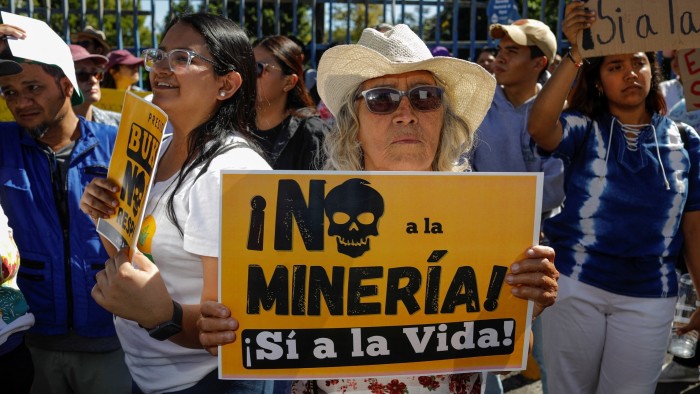
El Salvador’s congress has recently taken a significant step by lifting a comprehensive ban on metal mining. This decision is seen as a victory for President Nayib Bukele, who has faced opposition from various environmental and religious groups regarding the move. The ban, introduced in 2017 as a protective measure for the country’s water resources, was the first of its kind globally.
President Bukele, who assumed office in 2019, criticized the ban as “absurd.” His political party and its allies, who hold a dominant position in the legislature with 57 out of 60 seats, unanimously voted to repeal the ban. This change allows the Salvadoran government to have exclusive authority over mining activities.
In his second term, Bukele aims to rejuvenate El Salvador’s economy and attract foreign investments. He has estimated that the country may hold gold reserves worth around $3 trillion, although experts have expressed skepticism about this claim, which is based on an undisclosed study.
Previously, mining exploration in El Salvador was limited. One of the most advanced projects was El Dorado, which was believed to contain approximately 1.4 million ounces of gold, potentially valued at about $3.6 billion today, excluding production costs.
El Salvador’s gold belt is located in its northern provinces, intersecting with the watershed of the Lempa River, the main water source for the densely populated nation. Concerns about the impact of mining on water resources and possible pollution from toxic substances like cyanide led civil society to call for a 10-year mining moratorium in 2007. This culminated in the implementation of the ban in 2017.
The Catholic Church, which played a vital role in establishing the ban, has publicly urged against its repeal. A recent national poll revealed that 59.2% of respondents believe that mining is inappropriate for El Salvador, while 23% were in favor of it.
President Bukele has promised that mining operations will be “modern and sustainable,” asserting that gold mining could significantly change the future of El Salvador. The price of gold has also seen dramatic increases, recently exceeding $2,600 per ounce, reaching a record high.
During his first term, Bukele implemented tough measures against gangs, leading to the detention of around 82,000 suspects without trial. This resulted in a significant drop in the murder rate and a surge in his popularity. Bukele was re-elected in February with 85% of the vote, despite legal debates about the constitutionality of his re-election.
El Salvador recently secured a $1.4 billion loan agreement with the IMF. The country has committed to reducing its budget deficit and strengthening international reserves as part of this deal, which includes making the acceptance of bitcoin voluntary for the private sector.