

Key Details:
- Massachusetts is launching bidirectional electric vehicle (EV) chargers at no cost for selected customers. This initiative is part of a two-year demonstration program aimed at exploring how residential, municipal, and school customers can use EV batteries for backup power and improving energy self-consumption.
- According to Elijah Sinclair, a senior program manager at the Massachusetts Clean Energy Center, the goal is to have between 70 and 80 chargers installed by the end of summer. The program includes five school districts, four municipal entities, and over 45 residents.
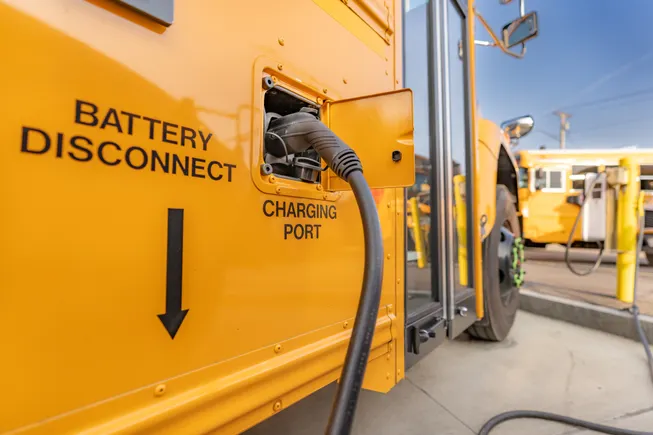
- Early data from participating school districts suggest that electric buses could both support the power grid and generate income for their operators. This pilot effort will help stakeholders understand how different EVs can interact with the grid as adoption increases.
Insights:
Bidirectional charging programs led by states and utilities are becoming more common across the U.S. For example, Pacific Gas & Electric in California has several similar programs. In Maryland, Baltimore Gas & Electric and Sunrun recently launched a pilot, backed by legislation that pushes for quicker installation of bidirectional chargers, enabling customer vehicles to participate in energy programs.
While not all EVs can send power back to the grid, more models are now equipped to do so, including the Ford F-150 Lightning, Nissan Leaf, Kia EV9, Volvo EX90, and Polestar 3. Five electric school bus models are also involved in the Massachusetts pilot.
The Massachusetts initiative received part of a $50 million grant authorized by the American Rescue Plan to enhance EV charging infrastructure and could simplify future installations and adoption of bidirectional chargers.
Sinclair indicated that the pilot’s outcomes could inform broader implementation and address common obstacles like upfront costs and installation challenges.
Additionally, Massachusetts offers one of the most attractive virtual power plant programs for owners of bidirectional-capable EVs. Participants could earn around $3,000 each summer for allowing their vehicles to contribute energy.
Electric school buses, with their sizeable batteries, could be particularly beneficial during peak summer demand periods, potentially earning significant funds each year. Reports suggest that these vehicles could earn up to $12,000 annually through energy contribution programs.
Utility companies are still figuring out how to manage these vehicles as energy resources. At a recent workshop, Sinclair noted concerns about balancing the energy needs of utilities with the usage rights of vehicle owners during power demand events.
Overall, with the size of EV batteries, even a small energy draw can significantly impact the power supply. Sinclair remains hopeful that utilities will find effective ways to manage these interactions.