

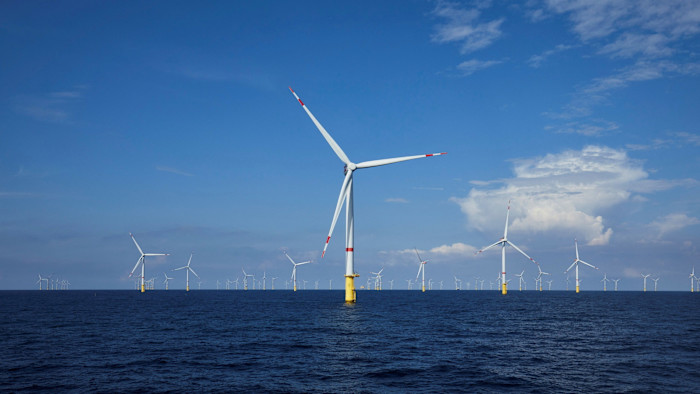
European nations are ramping up their efforts to achieve energy independence, a move that has gained momentum following remarks from US President Donald Trump regarding Greenland. At a recent summit in Hamburg, ministers from several countries, including the UK, Norway, Germany, and the Netherlands, announced plans to work together on developing an extensive offshore wind energy grid in the North Sea.
Dan Jørgensen, the EU’s energy commissioner, stressed the importance of moving away from reliance on Russian gas while ensuring that Europe does not become overly dependent on fuel imports from the US. The joint vision is ambitious: the nine participating countries aim to establish 15 gigawatts of offshore wind power annually from 2031 to 2040, with an ultimate goal of reaching about 300 gigawatts by 2050.
To support this initiative, plans are in place for around 100 gigawatts of offshore wind projects by 2050, which will involve creating a network of cables to connect wind turbines across multiple countries in the North Sea. This commitment comes amid growing concerns over energy security after Russia’s invasion of Ukraine, which prompted reduced gas supplies to Europe.
The summit also saw EU officials finalize a complete ban on imports of Russian gas by 2027. Addressing questions about Greenland, Jørgensen emphasized that while Europe welcomes trade with the US, it is crucial to avoid becoming dependent on new energy sources.
Trump’s previous threats to acquire Greenland have strained transatlantic relations, though he recently softened his stance, expressing a desire for future agreements on the territory instead. As part of a broader trade deal, the EU has agreed to purchase $250 billion worth of US energy annually, including both gas and nuclear technology.
The shift towards US liquefied natural gas has been significant, with imports surging from 21 billion cubic meters in 2021 to a projected 81 billion cubic meters by 2025. Currently, US shipments constitute 57% of the EU’s LNG supply, raising concerns among energy analysts about over-dependence.
Historically, Russian gas provided nearly 40% of the EU’s energy before 2022. As a result, governments across Europe and the UK are increasingly looking to renewables as a more reliable energy source.
Additionally, recent measures by European ministers are designed to revive the offshore wind industry, which has faced challenges due to rising costs and grid access delays. Trade group WindEurope noted that more countries are now considering revenue guarantees for developers, following unsuccessful subsidy-free auctions in Denmark and Germany.
Under these agreements, wind developers receive compensation if electricity prices dip below a guaranteed rate, while they must pay back the difference if prices rise. With stronger political backing, the industry is optimistic about reducing costs by 30% by 2040 compared to the current price levels of around €95 per megawatt-hour.