

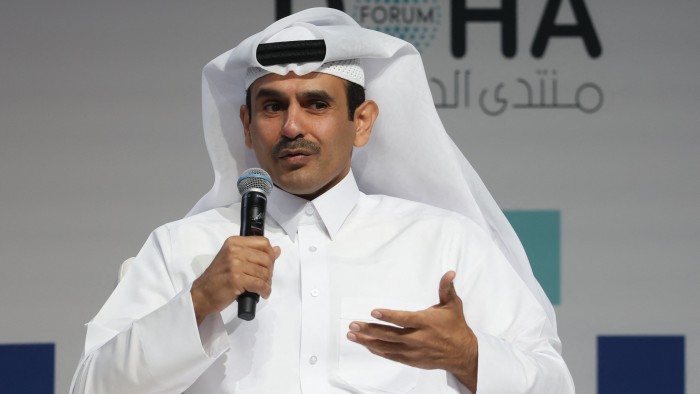
Qatar has voiced strong opposition to new EU regulations that may penalize companies for not adhering to criteria on carbon emissions and labor rights. Saad al-Kaabi, Qatar’s energy minister, stated that if any EU country enforces penalties as outlined in the corporate due diligence directive, Qatar would halt its exports of liquefied natural gas (LNG) to the European Union.
The proposed law allows EU nations to impose fines for non-compliance, with penalties potentially reaching up to 5% of a company’s global annual revenue. Kaabi emphasized that Qatar, which relies heavily on its energy sales, cannot afford to lose such significant amounts of money. He remarked, “If it means I lose 5% of my revenue by selling to Europe, then I won’t sell to Europe… This is the people’s money.”
Adopted in May, the new corporate due diligence rules are part of broader initiatives aimed at helping the EU achieve its goal of net zero emissions by 2050. However, these regulations have faced backlash from various companies who argue they impose excessive burdens and could threaten their competitiveness.
The European Chemical Industry Council (Cefic) has warned that the due diligence rules may expose companies to substantial litigation risks and should undergo careful review to simplify and reduce the burdens involved.
Penalties will apply to non-EU companies earning more than €450 million in the European market. As one of the world’s leading LNG exporters, Qatar has become increasingly vital to Europe following the energy disruptions caused by Russia’s invasion of Ukraine. In this context, QatarEnergy has secured long-term contracts to supply gas to several European nations, including Germany, France, and Italy.
Kaabi voiced concerns over the practicality of the legislation, which is set to take effect in 2027. He noted that it would require extensive checks on labor practices throughout a vast supply chain that involves approximately 100,000 companies.
He remarked, “To enforce this, I would need to hire many more people or spend millions on services to audit each supplier.” Furthermore, he indicated that meeting the EU’s net zero ambitions would be unfeasible for an energy producer like QatarEnergy due to its current production levels.
The EU directive mandates that large companies adopt transition plans for climate change, striving to align with the Paris Agreement objectives. Kaabi pointed out that the regulations would impact all Qatari exports to Europe, which includes not only LNG but also fertilizers and petrochemicals, potentially influencing investment strategies of Qatar’s sovereign wealth fund.
While he assured that QatarEnergy would not breach LNG contracts, he expressed readiness to explore legal options if faced with heavy penalties, stating, “I will not accept penalties. I will stop sending gas to Europe.” However, he also hinted at the possibility of compromise, suggesting that penalties should be based solely on revenue generated from contracts within Europe, not total global revenue.
European Commission President Ursula von der Leyen indicated last month that she intends to propose legislation to streamline reporting requirements for several green finance laws, including the due diligence directive, which could offer some relief to companies facing these stringent rules.