

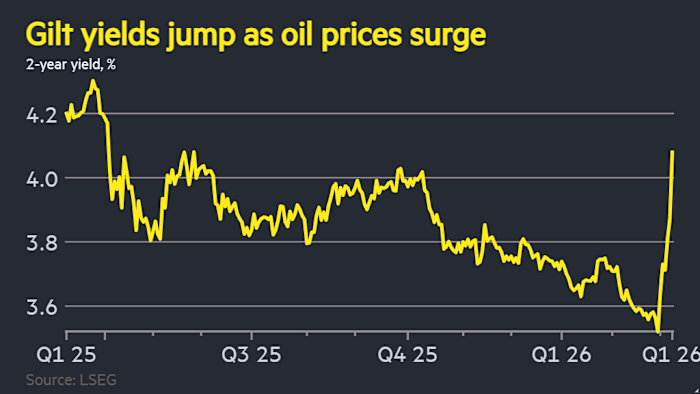
A significant sell-off in the UK government bond market, known as gilts, intensified on Monday as fluctuating energy prices raised concerns about inflation. As a result, traders are increasingly predicting an interest rate hike from the Bank of England.
The yield on two-year gilts jumped by 0.24 percentage points to 4.12%, marking one of the largest single-day increases in recent memory. Similarly, the yield on ten-year gilts rose by 0.11 percentage points to 4.73%. Yields rise when bond prices fall.
The gilt market is experiencing a global trend of rising bond yields, largely driven by rising oil and gas prices amid escalating tensions in the Middle East. This has led investors to reassess their outlook on future interest rates.
“The shift in central bank expectations has been swift and harsh,” remarked Moyeen Islam, who leads UK rates strategy at Barclays. He noted that the current market is reflecting the patterns seen in early 2022, where rising energy prices led to increased inflation and, subsequently, higher yields.
Currently, market traders estimate about a 50% chance that the Bank of England will raise rates by a quarter percentage point before the year concludes. Just a week ago, traders anticipated two rate cuts.
Prospects for rate cuts in several major economies are fading. The market is now forecasting two rate hikes from the European Central Bank by year-end, a shift from earlier expectations of further cuts.
In the United States, predictions have also adjusted; instead of the previously expected two or three rate cuts, just one or two are now anticipated.
Gilts have been particularly sensitive, as the Bank of England was expected to lower rates more aggressively than other central banks this year.
On the global stage, oil prices continued to rise, with Brent crude surpassing $100 a barrel for the first time in four years. European gas prices also increased by around 13%.
The recent spike in energy prices follows military actions by the U.S. and Israel against Iran, igniting a regional conflict that has disrupted oil and gas supplies.
“Gilts are reacting more acutely to energy price changes compared to other markets, though this response might be disproportionate,” stated Jason Borbora-Sheen, a portfolio manager at Ninety One.
Yields on two-year gilts have escalated by about 0.6 percentage points since the beginning of the conflict, reaching their highest levels since March 2025.
As the situation unfolds, the negative implications of higher oil prices on economic growth will need to be factored into market expectations, Borbora-Sheen emphasized.