

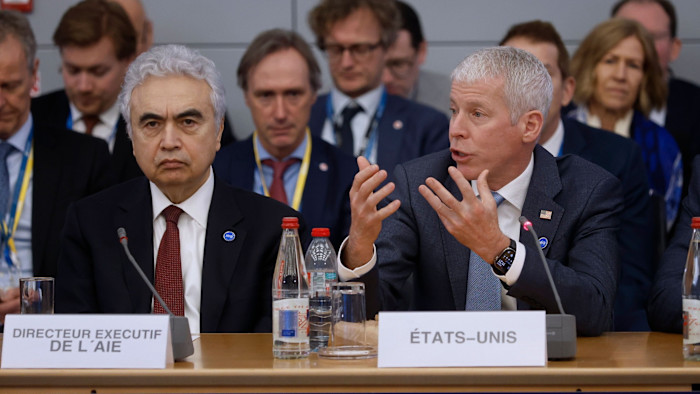
Energy ministers recently concluded a two-day meeting in Paris organized by the International Energy Agency (IEA), but they did not reach a consensus on strategies to combat climate change. This gathering was marked by a strong criticism of net-zero goals from the U.S. Energy Secretary Chris Wright.
For the first time in several years, the ministers failed to put forth a united statement, highlighting divisions stirred up by the U.S. They emphasized the need for renewable energy sources, with countries like the UK, France, and Spain underscoring their importance.
The chair of the meeting, Dutch energy minister Sophie Hermans, noted that a significant number of ministers acknowledged the crucial role of energy security while discussing the importance of transitioning to cleaner energy to tackle climate change. The meeting referenced the UN’s climate agreement in Dubai, which calls for a global shift towards net-zero emissions, yet it also underscored the ongoing significance of oil and gas.
IEA director Fatih Birol remarked that energy security was deemed fundamental in discussions among the ministers. The absence of a joint statement marks a departure from previous IEA meetings, where there was broad agreement on climate issues.
During their last meeting in 2024, ministers expressed that worsening weather conditions make it urgent to hasten clean energy transitions. Discussions pointed to a “triple planetary crisis” involving climate change, pollution, and biodiversity loss.
This year, however, the support for climate action appeared to be tepid, largely influenced by U.S. critiques of the IEA’s net-zero policy. The U.S. has threatened to withdraw from the IEA but wants to avoid giving China greater influence over the agency.
Wright, who also leads the oil group Liberty Energy, announced he would continue advocating against net-zero policies at the IEA. Birol mentioned that he has yet to decide if he will seek renewal of his term once it ends in September 2027. He did highlight the addition of four new countries—Colombia, Brazil, India, and Vietnam—to the IEA.
On the sidelines of the event, UK Energy Secretary Ed Miliband defended Britain’s commitment to expanding clean energy sources, stating that while countries pursue national interests, the shift towards clean energy is inevitable for most. His French counterpart Roland Lescure echoed this sentiment, emphasizing the necessity of investing significantly in decarbonized energy.
Both ministers expressed hope for Europe and the U.S. to find common ground on other priorities, such as expanding nuclear energy. Irish Energy Minister Darragh O’Brien noted that it is beneficial for the U.S. to remain a part of the IEA.
Despite the disagreements, there was a consensus on enhancing monitoring of critical raw materials and promoting access to clean cooking fuels, aided by U.S. support.