

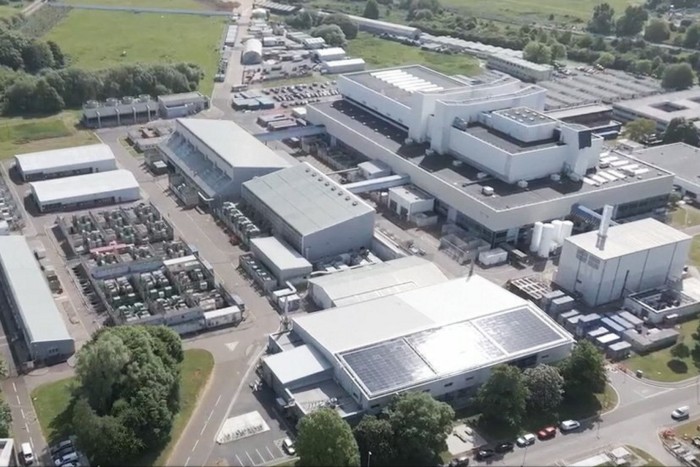
A fusion energy company supported by Google and Chevron is partnering with the UK’s atomic laboratory to commercialize parts of its technology for medical and industrial uses within two years. TAE Technologies, a U.S.-based firm and one of the oldest players in the private fusion sector, has signed an agreement with the UK Atomic Energy Authority, which will invest £5.6 million into the new venture located in Oxfordshire.
Although experts indicate that consistent fusion power is still years away, the technology TAE employs—neutral-beam technology—holds promise for applications beyond energy, including cancer treatment. TAE plans to deliver its initial short-pulse neutral-beam product for clinical and industrial purposes within two years, according to their recent announcement.
TAE’s CEO, Michl Binderbauer, emphasized the importance of exploring revenue-generating markets while working on fusion energy. Though the fusion energy market could be massive, practical fusion power remains a challenge. He highlighted the complexities involved in financing such projects due to high development costs and long timeframes.
With substantial backing, including $1.3 billion in investment, TAE hopes to start producing electricity from fusion in a pre-commercial phase by the early 2030s. Binderbauer acknowledged that the journey is more complicated and time-consuming than many anticipate.
In contrast to typical nuclear power, which relies on splitting atoms, fusion power merges atomic nuclei. The neutral beam acts like a precision tool, delivering energy to superheated hydrogen fuel that must reach temperatures exceeding 100 million Celsius—the heat causes the nuclei to combine.
Given that no material can endure such extreme conditions, fusion reactors utilize strong magnetic fields to keep the fuel away from the reactor walls, while high-energy beams navigate these fields unimpeded.
Although physicists achieved fusion as early as the 1930s, no experiment has ever generated more energy than it consumed. Nevertheless, fusion companies have attracted significant investment, amassing $2.64 billion in the year leading up to July, according to the Fusion Industry Association. Much of this funding stems from firms seeking sustainable energy sources, particularly for powering advanced technologies like artificial intelligence.
The technology behind TAE’s neutral beam also shows potential for medical applications, such as targeting cancer tumors, with some countries already utilizing it. The UK Atomic Energy Authority noted that this partnership aligns well with the country’s fusion strategy to build a domestic fusion supply chain.