

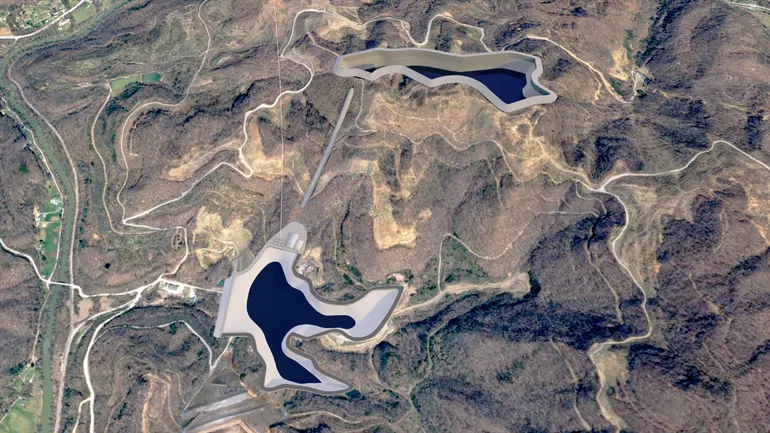
Two utilities in Kentucky, Louisville Gas and Electric and Kentucky Utilities, are working on a significant pumped storage project estimated to cost $1.3 billion. This initiative aims to enhance the state’s power supply as demand continues to climb.
Rye Development, which has several pumped storage projects underway, received preliminary approval for the Lewis Ridge project from the Federal Energy Regulatory Commission (FERC) back in 2022. They filed for a license application in June, marking a notable moment as it’s been decades since a large-scale pumped storage plant was built in the U.S.
John Crockett III, president of LG&E and KU, noted that this project would be “a compelling initiative.” He emphasized its significance as it would be Kentucky’s first pumped storage facility, contributing to a more diverse and sustainable energy mix.
Originally, Rye Development focused on increasing energy output at non-powered dams, typically small projects. However, about four years ago, they shifted to pumped storage, currently developing seven to eight projects at a time. CEO Paul Jacob mentioned, “This is an amazing time,” driven by factors like AI and rising industrial energy needs across the country.
This project would involve a partnership where Kentucky Utilities would hold a 63% stake, and LG&E would own 37%. Their ownership could change based on load demands and resource strategies as they seek approvals from state regulators.
The project, while ambitious, may require a partnership with a data center hyperscaler to achieve economic viability, given the high estimated cost of around $4.9 million per megawatt.
Located near Blackmont, Kentucky, the Lewis Ridge project will harness water resources to generate 266 MW of power for up to eight hours. It will draw water from the Cumberland River and its tributaries for recharging during low demand times, typically at night.
Rye Development is projecting the project could generate around 60 GWh monthly, equating to approximately 717 GWh annually. They anticipate selling this capacity to utilities for between $25 to $30 per kilowatt-hour.
The need for such projects arises as Kentucky faces challenges from aging fossil fuel plants. The Lewis Ridge initiative aims to enable local utilities to tap into excess grid energy during low demand periods and provide power when demand surges, essential in extreme weather conditions.
If granted the necessary approvals, Rye Development hopes to start construction by December 2027 and aims to complete the project in about four years.
The anticipated construction cost totals roughly $1.2 billion, with additional expenses estimated at $110 million during the building phase. Rye also indicated that the project’s licensing application cost around $15 million to put together.
Support for this project includes $81 million in funding from the U.S. Department of Energy towards clean energy initiatives on former mining lands. Rye Development is currently expanding its pumped storage project portfolio in the U.S., with backing from EDF Power Solutions and Climate Adaptive Infrastructure.
In December, FERC approved another 1.2-GW pumped storage project by Rye Development, which will be located on the site of a former aluminum smelter in Washington.
The need for pumped storage solutions varies by region. In the West, it’s driven by integrating renewable energy, while in the East, it serves to balance energy loads. Beyond acting as a peak power provider, these facilities offer significant benefits, especially during weather extremes.
Currently, the U.S. has about 20.1 GW of pumped storage capacity, with FERC reviewing proposals for new projects totaling 2.7 GW across multiple states. The agency has issued preliminary permits that could lead to additional capacities, signaling a growing interest in this energy storage solution.