

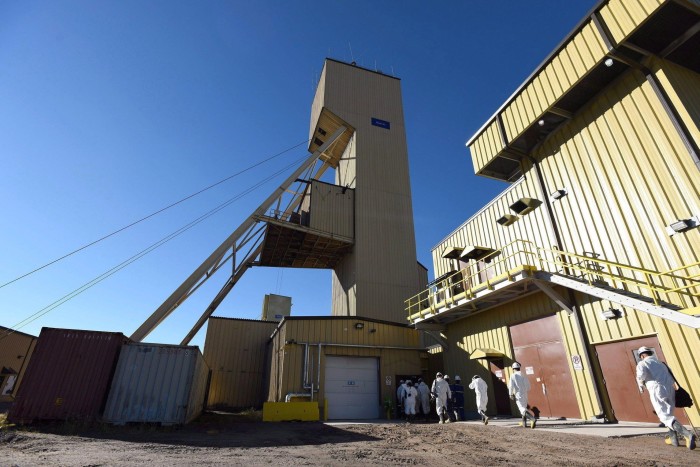
Canada is quickly moving toward becoming the world’s top uranium producer. This surge comes as demand for clean nuclear power rises and geopolitical issues put supplies at risk.
Cameco, the nation’s leading uranium producer, has announced that it plans to increase production by nearly 30% in 2024, aiming for 37 million pounds from its mines located in northern Saskatchewan, which is at the center of Canada’s uranium sector. Other companies, including Denison Mines, Orano Canada, Paladin Energy, and NexGen Energy, also have plans to develop new mines and expand existing operations. According to RBC Capital Markets, these initiatives could potentially double Canada’s uranium output by 2035.
Jonathan Wilkinson, Canada’s Minister of Energy and Natural Resources, remarked that investment in the uranium sector is at its highest level in 20 years. Spending on exploration and development jumped by 90% to 232 million Canadian dollars (approximately 160 million US dollars) in 2022, with an additional 26% increase forecasted for 2023, bringing it to around 300 million Canadian dollars.
Wilkinson emphasized that Canada not only produces enough uranium for its own reactors but is also the only G7 nation that can supply uranium to allies, exporting over 80% of its production.
The industry is keen to capitalize on the rising uranium prices that exceeded $100 per pound in January last year—a level not seen since 2008. Although prices have since decreased to around $73 per pound, this figure is still significantly higher than the average of below $50 over the past 10 years.
Canada’s uranium industry is on its way back after being the leading global producer until 2008, when it contracted due to falling prices after the Fukushima disaster in 2010, which severely impacted the nuclear industry in the West. This decline allowed Kazatomprom, a state-owned enterprise in Kazakhstan, to emerge as the largest producer, with Kazakhstan accounting for 43% of worldwide uranium output by 2022. Canada trailed behind with only 15%, followed by Namibia at 11%.
However, the situation may be changing in Canada’s favor as global demand for uranium is expected to grow. This is largely driven by 31 countries committing to triple nuclear energy capacity by 2050 to address climate change. Major tech companies like Amazon, Google, and Meta are also increasingly turning to nuclear energy to power their data centers since it produces no greenhouse gas emissions.
NexGen is working on the Rook1 mine in the Athabasca Basin of northern Saskatchewan, which it anticipates will outpace Kazakhstan’s production within five years, enhancing energy security for the Western nuclear industry. Leigh Curyer, CEO of NexGen, noted that the project could position Canada as a leader in uranium production again.
Curyer mentioned that US utilities are expressing interest in purchasing uranium from the Rook1 site, which, pending approvals, could start construction in mid-2025. The projected cost for the mine is around 1.6 billion US dollars, and once operational, it could generate 30 million pounds of uranium annually, amounting to nearly 20% of current global production.
In addition to NexGen, Denison is advancing the Wheeler River project while Paladin Energy is working on Patterson Lake, both of which could yield up to 18 million pounds of uranium every year. Cameco is also considering raising production at McArthur River by over one-third to reach 25 million pounds per year.
Grant Isaac, chief financial officer at Cameco, remarked that the industry is experiencing unprecedented tailwinds, confirming the increasing demand for uranium. Analysts from BMO Capital Markets highlighted that the interest from big tech firms in nuclear energy could lead to significant private investment alongside favorable government policies, marking a resurgence in uranium interest.
While other countries like Australia and the US are also planning uranium expansions, their efforts are smaller compared to Canada and Kazakhstan, which have the capacity to scale up.
Kazakhstan, which produces 23% of the world’s uranium, faced challenges last year due to a shortage of sulfuric acid affecting its mining operations. Additionally, geopolitical tensions following Russia’s invasion of Ukraine in 2022 have complicated supplies for Western countries. In August, the US banned Russian uranium imports to enhance energy security, although some contracts remain exempt until 2027. In turn, Russia imposed restrictions on its uranium exports to the US.
China has become the primary buyer of Kazakhstan’s uranium and recently acquired stakes in some deposits developed alongside Rosatom, Russia’s nuclear energy company. This shift in trade patterns raises concerns for Western utilities, especially if reliance on Kazakh uranium continues to grow.
According to Isaac, the ongoing conflict in Ukraine has prompted some Western utilities to explore alternatives to Russian-linked supplies, although many are opting to wait for clarity regarding the situation before committing. This delay in decision-making could lead to a supply crunch and drive prices higher in the coming years.