

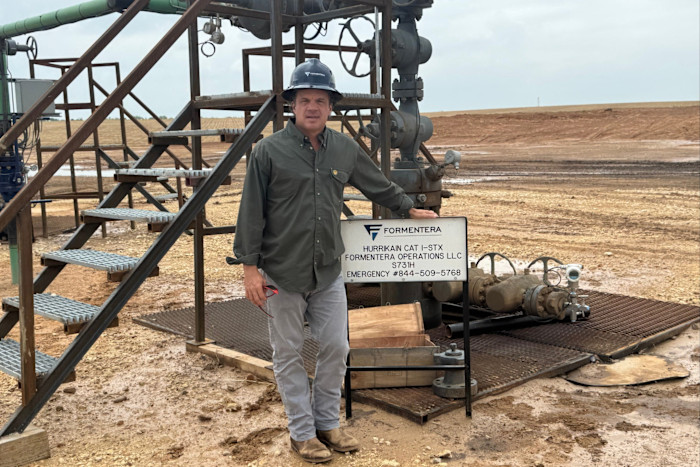
Bryan Sheffield has built his wealth through oil drilling, a legacy passed down from his father and grandfather. However, as activity in the Permian basin cools down, he is focusing on taking the success of fracking to other countries.
Sheffield is the leading shareholder in Tamboran Resources, a company with drilling rights over nearly 2 million acres in northern Australia’s Beetaloo basin. Tamboran plans to kick off gas sales from a pilot shale project in the coming year.
Additionally, his private equity firm, Formentera Partners, is eyeing shale opportunities in Venezuela, especially after the ousting of Nicolás Maduro.
“The Permian has been a huge economic booster for the U.S., but we’ve already tapped into the best reserves and are running low on options,” Sheffield noted. He previously started Parsley Energy and sold it for $7.5 billion in 2021.
“Americans will need to search beyond their borders in the next few years and leverage their expertise to explore new shale regions,” he added.
The shale boom began in the mid-2000s with innovations like hydraulic fracturing that unlocked enormous reserves, propelling the U.S. past Saudi Arabia and Russia to become the top oil and gas producer. This boom created numerous jobs and enhanced American energy independence.
However, production growth seems to have plateaued. The U.S. Energy Information Administration predicts a slight drop from 13.6 million barrels per day in 2026 to 13.2 million in 2027, as companies tighten their budgets amid low crude prices.
“There’s little expectation for significant growth in U.S. shale, and some anticipate a gradual decline soon,” said Ruaraidh Montgomery from market intelligence firm Welligence.
To adapt, many U.S. shale companies are branching out internationally and forming local partnerships to gain an early advantage over competitors.
Experts see potential in the Middle East, with companies like EOG Resources partnering with oil firms in the UAE and Bahrain. Harold Hamm from Continental Resources is also seeking opportunities in Turkey and Argentina.
“We recognize the issues with U.S. unconventional resource quality,” said Doug Lawler, CEO of Continental Resources, explaining that a plateau in U.S. oil production is prompting a shift abroad.
Yet, operating outside the U.S. comes with its own hurdles. One executive highlighted the need for a fresh approach and time to adapt to different business practices.
International oil service firms, like Halliburton, provide support, but only local drilling operators are allowed to drill for oil and gas, adding to the complexity.
In Australia, Tamboran has enlisted U.S. hydraulic fracturing specialists to enhance project efficiency. Recently, Baker Hughes invested $10 million in Tamboran’s $56 million fundraising efforts.
Sheffield, whose father founded Pioneer Resources, which was bought by ExxonMobil, expects that interest in the Beetaloo basin will grow once gas sales begin.
Chevron has been operating in Argentina’s Vaca Muerta area—where production has significantly increased since 2013.
Analysts say attractive geology is critical for attracting foreign investment, but economic stability and business environment also play significant roles. The recent election of a pro-business president in Argentina has reassured U.S. investors, but many are still pushing for better fiscal policies.
Niemeyer from Chevron acknowledged that production costs in Argentina are about 35% higher than in the Permian, but progress is being made.
He believes there’s potential for Argentine production to triple by 2035 if the right conditions are met.