

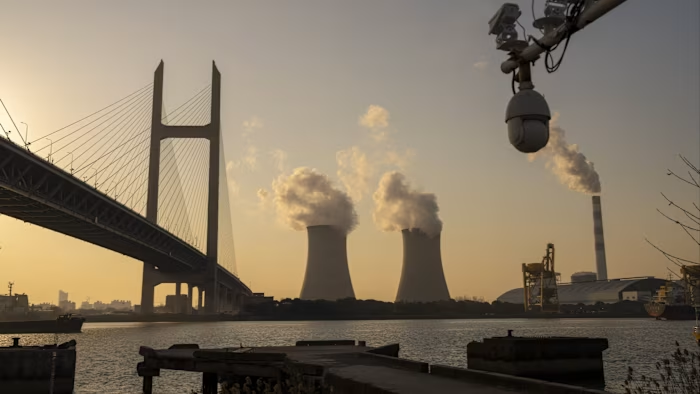
In 2026, over 100 coal-fired power station units are expected to come into action globally, primarily fueled by China’s ongoing development of fossil fuel projects. This is happening against a backdrop of significant growth in wind and solar energy production in the country.
According to a report by Global Energy Monitor, the 104 projects set to launch this year are part of a total of 439 coal plants currently under construction. This highlights a continuing dependence on coal power, despite advancements in cleaner energy technologies.
China represents the bulk of these projects, accounting for about 212 gigawatts out of a total of 256 gigawatts of new coal capacity being developed globally. A staggering 85 coal units are slated to go online in China by 2026, contributing to 55 gigawatts of the total 63 gigawatts worldwide. However, the final numbers may vary depending on construction schedules.
Interestingly, while coal power capacity is on the rise in China, it has seen a decline in other parts of the world. Reports indicate that construction of coal-fired power plants has fallen outside of China, while its domestic projects are at their highest levels since 2016.
Other countries, including India, Vietnam, and Indonesia, are also in the process of building new coal plants, with India alone working on around 24 gigawatts of capacity.
Christine Shearer, an analyst with Global Energy Monitor, mentioned that the global shift away from coal primarily hinges on China. She expressed skepticism about seeing much new construction elsewhere, as the world grapples with a transition to renewable energy sources. However, she noted that the growing proportion of renewable energy in China’s power mix is changing how often coal plants operate.
Data from S&P Global Ratings suggests that by 2030, Chinese coal plants will operate for approximately 4,100 hours a year at full capacity, down from 4,400 hours in 2025. Shearer indicated that this shift requires new coal plants to adapt to a rapidly changing energy landscape dominated by solar and wind power, while emphasizing that investments would be better directed towards cleaner energy alternatives, like batteries.
While new coal plants are being constructed, China is also retiring older coal units at an average rate of about 3 gigawatts annually from 2021 to 2025. The country continues to lead in renewable energy, having installed 240 gigawatts of new solar capacity within the first nine months of 2025.
A recent analysis by the Centre for Research on Energy and Clean Air revealed that coal power generation in both China and India fell in 2025 for the first time in over five decades, indicating a significant shift in energy production.
Globally, coal use is projected to reach record highs, driven in part by increased demand in the US and slower transitions in Europe. The International Energy Agency noted that while global coal use seems to be plateauing, there are still complexities involved, especially among emerging markets and established systems facing challenges in phasing out coal.
In a landmark statistic, renewable energy sources generated more electricity than coal in the first half of last year, showcasing a significant shift towards cleaner energy solutions as global electricity needs evolve.