

Bechtel, the construction company that saved the last major U.S. nuclear project from going bankrupt, is urging the government to share the financial risks tied to cost overruns. This collaboration could help realize Donald Trump’s vision for a nuclear energy revival in America.
Craig Albert, the president of Bechtel, believes that the nuclear industry can meet the goals set out by the President’s executive orders to develop ten large nuclear reactors by 2030. However, for this to be successful, both the government and private companies need to join forces to tackle the challenges of funding, especially issues related to cost overruns and delays.
Albert highlighted in an interview that “no one company can shoulder all the risk,” as taking on such burdens could jeopardize their entire operation. While he acknowledged that tax incentives from the government improve investment returns, they don’t sufficiently address the risk of cost overruns. He emphasized that the government must play a crucial role in mitigating these risks.
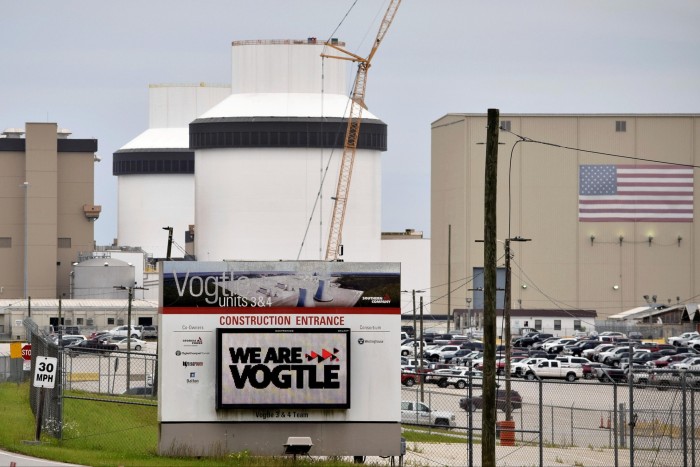
The two most recently constructed reactors in the U.S., located at Plant Vogtle in Georgia, faced significant delays and ended up costing over twice the original estimate of $14 billion, ultimately leading to Westinghouse’s bankruptcy in 2017. Bechtel was later chosen to finish the project, marking the first nuclear reactor construction in over three decades.
Despite Bechtel’s efforts at Vogtle, the project encountered its own share of delays and budget issues, emphasizing the inherent difficulties of large-scale nuclear endeavors.
Albert stated that Bechtel is prepared to adapt its contracting practices and accept more risk. Historically, the company engaged in cost-reimbursement contracts, which shielded them from “no cost” risks. However, they are currently evaluating which parts of their projects they can confidently control to assume some risk of overruns. “If everyone contributes to taking on some risk, a solution is possible,” he said.
In May, Trump ordered the nuclear sector to expedite the construction of both large and small nuclear reactors with a goal to quadruple the United States’ nuclear capacity by 2050. This directive has energized the industry, enabling companies to secure substantial funding for various projects.
Nevertheless, experts warn that the nuclear industry’s track record in managing projects on time and within budget remains a challenge. For instance, in the UK, the Hinkley Point C nuclear facility’s costs ballooned to £46 billion from initial projections of £18 billion.
The Nuclear Energy Institute supports a proposed bill in Congress aimed at alleviating the financial burdens of cost overruns in nuclear projects. John Kotek from the NEI pointed out that policies that reduce potential construction overruns can enhance investor confidence.
According to the draft legislation, the initial 20% of any cost overruns would be the project’s responsibility, followed by a 50-50 cost-sharing agreement with a government cap at $1.2 billion. While some experts argue that this could create problems of accountability, they advocate for more proactive funding strategies instead.
Albert believes that delivering nuclear projects on schedule and within budget relies on an integrated approach to engineering, construction, and procurement. He asserted that traditional bidding models simply do not work for complex projects like nuclear power plants.
To be successful, companies must ensure they have an adequate number of skilled workers, establish supply chains early, and manage risks effectively. “We aim to provide accurate pricing that investors can trust. It’s about preventing costly surprises,” Albert said, reflecting on how Vogtle’s estimates should have been higher from the start.
Drawing from Bechtel’s extensive experience in constructing liquefied natural gas plants, Albert sees a pathway to effectively manage the initiation of multiple nuclear units by being strategic in project sequencing and execution.