

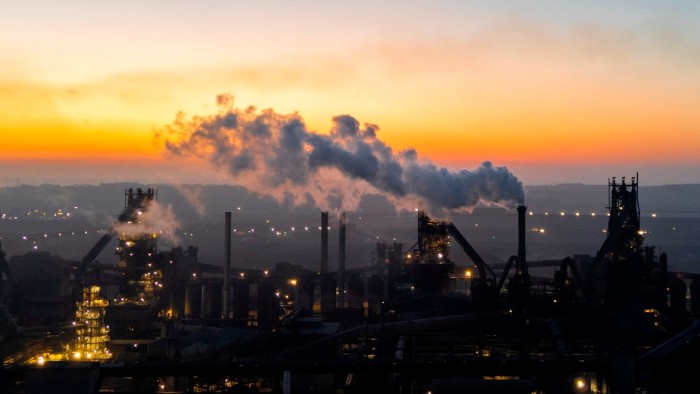
The UK government has taken significant action to rescue British Steel, the operator of the nation’s last two blast furnaces located in Scunthorpe, Lincolnshire. In an urgent move, Parliament was summoned back from recess to approve emergency legislation. This new law allows the government to take control of the plant while securing vital iron ore and coal supplies to keep operations running. There is now a strong possibility of temporary nationalisation, but a clear plan for the future remains unclear.
The current owner, Jingye from China, demanded double the £500 million the government was willing to provide to support the business and transition to more environmentally friendly electric arc furnaces. He argued that the total cost would be around £2 billion. With concerns that Jingye was not fully committed to running the blast furnaces, the government stepped in to prevent further decline. Officials played down accusations that China was trying to damage the UK steel industry, suggesting that Jingye was merely negotiating vigorously for more financial support.
Shutting down Scunthorpe’s blast furnaces would leave the UK as the only country in the G20 unable to produce primary steel from raw materials. Instead, electric arc furnaces create steel from recycled scrap. The current debate grapples with whether to keep the furnaces running temporarily for a seamless transition to new technology or to maintain them longer for some level of primary steel production in Britain. While there is a longing to retain jobs and nostalgia for the past, the reality is that these furnaces are aging and economically unviable, reportedly losing £700,000 daily.
In today’s landscape of US-China trade tensions and geopolitical instability, ensuring that the UK maintains some level of steel production is vital for economic resilience. However, this need not exclusively rely on blast furnaces. Advances in electric arc furnace technology allow for the production of most steel grades, and Britain has a sufficient supply of scrap material.
The Labour Party has earmarked £2.5 billion for steel support as part of a broader strategy. More detailed plans are essential for not only British Steel but the entire steel sector. Given the breakdown in trust with Jingye, a short-term nationalisation appears necessary. However, to secure Scunthorpe’s future, the government must attract a new investor who can establish a sustainable business model.
This includes moving forward with the electric arc furnace plan and providing support similar to the £500 million previously offered to Jingye, as well as to Tata Steel in Port Talbot, Wales, for a similar shift. The location of Scunthorpe, which supplies 95% of the steel for UK rail tracks, makes it an attractive prospect for investors.
To enhance the viability of UK steel and other energy-intensive industries, the government must also move swiftly to lower industrial electricity prices, which are among the highest in developed nations. Critics often claim this high cost is due to the shift to renewables, but the reality is that wholesale prices are determined by the most expensive source needed to meet demand, predominantly natural gas. The government is currently reviewing the energy market, and proposals to revert to a pricing model based on long-run marginal costs for industry could provide a viable solution.
Rather than resort to piecemeal rescues, the government should outline a comprehensive industrial strategy that defines strategically important sectors. This involves identifying which industries the UK should maintain domestically and which can rely on friendly supply chains. Steel certainly qualifies as a sector where Britain should retain production capability, but not through the outdated blast furnace method for which a temporary extension has recently been granted.