

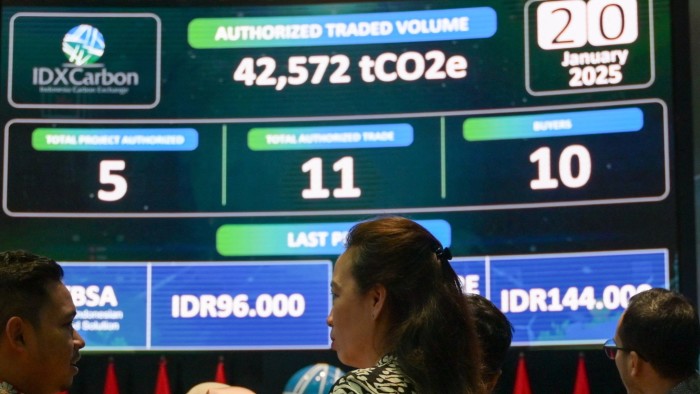
Indonesia is joining the growing number of Southeast Asian nations entering the global carbon market by selling carbon credits tied to energy projects. The government hopes that this initiative will help finance its shift to greener energy sources as it capitalizes on an increased interest in global carbon trading spurred by a recent UN agreement.
The UN pact established guidelines for a global market where countries and companies can trade credits representing reductions in carbon dioxide emissions. This framework is anticipated to enhance the market for voluntary carbon credits, which are not linked to mandatory emissions reductions.
According to data from MSCI Carbon Markets, the voluntary carbon credit market could see growth from $1.4 billion last year to as much as $35 billion by 2030.
Thailand plans to launch its own carbon market by 2025, and both Malaysia and Singapore are also eying opportunities in carbon trading. In this context, Indonesia has released 1.78 million carbon credits from five energy projects listed on IDX Carbon, its national stock exchange’s trading platform. These projects include both hydropower and more efficient natural gas operations, which contribute to emissions reductions.
However, some analysts express concern that offering credits based on fossil fuel projects may detract potential investors looking for more sustainable options, such as solar or wind power. Shabrina Nadhila, from the energy think tank Ember, mentioned that reputable brands are likely to shy away from projects using fossil fuel credits due to questions about their quality.
Further, MSCI has pointed out potential issues with the integrity of these credits, suggesting they may struggle to attract international buyers. Fitri Wulandri of Veyt, a carbon data provider, emphasized that the credits might rely on outdated standards, raising the risk that emission savings could be counted more than once—by both buyers and the Indonesian government itself.
To counter these issues, Indonesia’s Environment Minister Hanif Faisol Nurofiq assured stakeholders that the government has measures in place to avoid problems like double counting. He stressed that the credits are accountable for international trade and would align with Indonesia’s emissions commitments.
Trading began recently, with over 49,000 tonnes of credits sold on the opening day, and the exchange expects to sell a total of 750,000 credits this year. Indonesia, which boasts the world’s third-largest rainforest area after the Amazon and the Congo, could potentially introduce credits from forestry projects in the future.
As Indonesia grapples with energy production that is still heavily reliant on coal, experts note that achieving President Prabowo Subianto’s goal of reaching net-zero emissions by 2050 will necessitate significant reforms to fossil fuel-friendly laws. The country’s current system for managing emissions in the power sector, introduced in 2023, has faced criticism for its lack of effectiveness, particularly since there is no cap on the supply of emission allowances, contrasting with more rigorous systems like the European Union’s carbon market.