

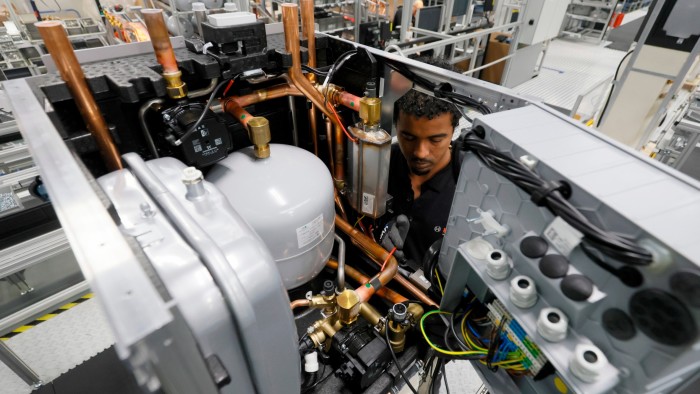
Sales of heat pumps in Germany have seen a significant increase recently. Many buyers are concerned that a potential conservative government may eliminate the generous subsidies currently available for switching from gas boilers to renewable energy heating systems.
Thermondo, Germany’s largest installer of heat pumps, reported a sales surge of 2.5 to 3 times compared to the end of October. They noted that the last week of November brought in a record number of new orders. Similarly, Enpal, a competitor, has had to continuously adjust its installation capacity to keep up with rising demand.
The conservative CDU/CSU bloc appears to be gaining traction ahead of the upcoming February election, and they have hinted at plans to abolish a law requiring new buildings to use heating systems that are at least 65% powered by renewable energy. This law was introduced by Green economy minister Robert Habeck and has been met with criticism from conservative media, which claimed it would force homeowners to remove their gas boilers.
In their election manifesto, the CDU/CSU pledged to stop the government from mandating what kind of heating systems homeowners can install. They state their intention to promote low-emission heating solutions without favoring any specific technology.
Under the current law, generous subsidies can cover up to 70% of the costs associated with purchasing and installing a new heat pump. Many supporters of the law are now worried that these subsidies could be at risk if the CDU/CSU takes power. These fears were heightened by Jens Spahn, a senior CDU MP, who stated that the party would end Habeck’s subsidy program if elected.
Despite this, Spahn later clarified that some form of state support would continue. The Federal Heat Pump Association highlighted a direct connection between the increased sales and the potential policy changes proposed by the CDU/CSU, suggesting that the fear of reduced subsidies is driving the current market surge.
As interest in heat pump grants grows, Susanne Ungrad from Habeck’s ministry reported a spike in applications, estimating around 6,000 to 8,000 each week. She assured that these applications are usually approved immediately and that the grant program would remain in place well into next year.
Germany’s heat pump sector has faced challenges, and even though 2023 was a record year with 356,000 units sold, only 200,000 are expected to be sold in the upcoming year. Proponents of the subsidies believe that operating costs for heat pumps will become more manageable in the future, despite their higher initial purchase price.
Upcoming EU legislation aims to reduce greenhouse gas emissions in the building sector, which is expected to significantly increase the cost of CO₂ emissions from gas boilers starting in 2027. This legislation was part of an agreement made in 2022 to establish an additional emissions trading system to address emissions from fuel combustion in buildings and transport.