

Plans are underway to transform Grangemouth, Scotland’s last oil refinery, into a hub for biofuels ahead of its scheduled closure next year. The vision for the site aims to utilize local resources, such as trees, crops, and even human waste to create a sustainable manufacturing process.
Consultants are racing to develop a strategy that not only revitalizes the local economy but also focuses on recycling and reducing environmental impact. There’s growing support from both UK and Scottish governments as they aim to secure jobs and help the region move towards a low-carbon economy following the refinery’s impending shutdown, which could result in the loss of over 400 jobs.
In response to Petroineos, the company operating the refinery, announcing the closure, the government launched a project called “Project Willow.” This initiative aims to formulate a low-carbon business model that could potentially replace some of the jobs lost in the transition, with completion expected by the end of January.
“Project Willow is centered on three major areas: recycling, biofuels, and hydrogen,” shared a source familiar with the findings. Currently, the project is about three-quarters complete, but the proposed recommendations may still change.
Even with the participation of Petroineos and various governmental bodies, it remains uncertain if they will adopt the green transition proposals. For the new technologies being examined, supportive regulatory changes and significant investments will be essential to attract private funding.
The project emphasizes creating a circular economy, with a strong focus on sourcing materials as locally as possible, ensuring the facility remains self-sufficient. Although new green initiatives might not create as many jobs as the existing refinery, there could be increased indirect employment in sectors like forestry, agriculture, recycling, and waste management.
Recycling plastics and chemicals will play a vital role in the facility’s future production, while processing sewage sludge might provide biomethane that can complement the UK’s natural gas supply.
Hydrogen, a key element in Scotland’s green strategy, would also be integral to Grangemouth’s plans, leveraging surplus offshore wind energy for production.
Project Willow has identified forestry as a critical resource for biofuel production. There’s potential for re-establishing Scotland’s timber industry by planting more trees to capture carbon dioxide and convert it into high-value products like sustainable aviation fuel.
While the idea of expanding forestry meets some local resistance, proponents argue that repurposing unused land for tree planting could benefit the environment and economy. They encourage discussions about current land use and future plans.
Non-food crops and waste oils are also on the table as feedstock alternatives. By adopting these crops into farming practices, farmers can not only generate additional income but also improve soil health—provided the government incentivizes these changes.
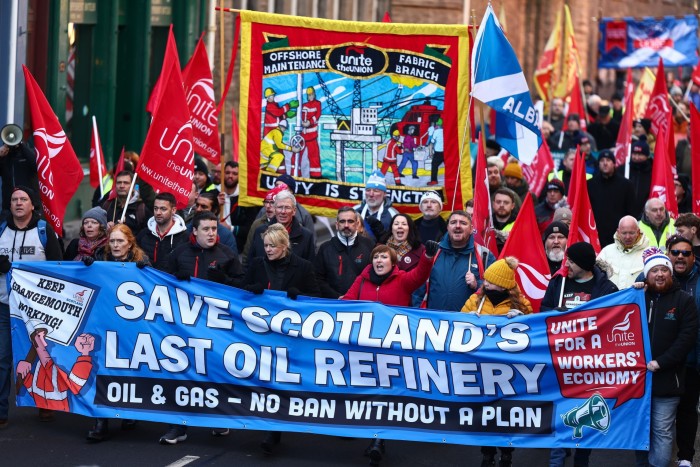
Unite, a labor union, is advocating for investment to increase the viability of the refinery alongside new low-carbon manufacturing strategies.
New facilities could be up and running within ten years, ramping up production throughout the 2030s and beyond as the region transitions into a greener future.