

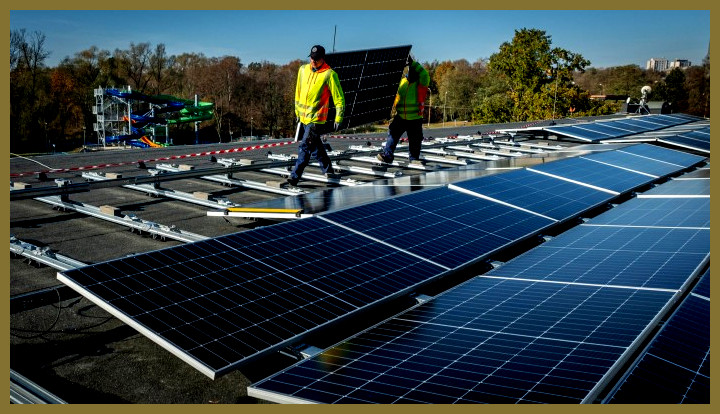
Investors are preparing to take legal action against the Czech government due to proposed reductions in solar power subsidies, sparking a debate about how European nations are handling the financial demands of transitioning to greener energy.
Three solar energy companies have cautioned Prague about potential lawsuits if the government proceeds with plans to retroactively cut subsidies for photovoltaic systems connected to the grid dating back to 2009.
This development coincides with similar actions in countries like Poland and Germany, which have begun to reassess their support for renewable energy projects. Industry experts are concerned that such moves could hinder the European Union’s climate objectives.
Walburga Hemetsberger, CEO of SolarPower Europe, described the situation as a troubling sign for future investments, stating it could discourage new projects and set a concerning precedent for other governments.
In defense of the proposed legislation, the Czech government argues that it is crucial to reduce the financial burden on taxpayers and adjust subsidies in alignment with the nation’s budget limitations.
The European Commission is keeping a close watch on the situation and has been in contact with involved parties.
The EU has ambitious goals for lowering emissions and boosting clean energy development, goals that have gained urgency as the bloc seeks to reduce its reliance on Russian fossil fuels following the 2022 invasion of Ukraine.
However, challenges like bureaucratic delays and supply chain obstacles, compounded by requests from local manufacturers to avoid purchasing less expensive Chinese solar panels, continue to slow the shift to renewable energy.
According to the International Energy Agency, the Czech Republic has one of the lowest numbers of solar parks in Central and Eastern Europe and still depends heavily on coal for more than a quarter of its energy supply.
Despite falling behind neighboring countries, the Czech government’s recent actions to discourage investments in renewable energy serve as a warning to investors considering future commitments, remarked Jan Krčmář, head of the Czech Solar Association. He noted that such changes send a concerning message about the stability of laws governing investments.
The current solar subsidy system was introduced in the Czech Republic in 2005, intended to operate for 20 years and effectively spurring the growth of solar energy as it attracted safe investment options backed by the government. Many households, small businesses, and foreign investors took out loans for solar panel installations that they are still paying off. The subsidy payments are estimated to cost the government between €1 billion and €1.2 billion annually.
In its recent communication to the EU, the Czech government expressed a desire to accelerate the deployment of renewable energy yet cited “insufficient subsidy support” as a primary obstacle to progress in this sector.
Pavel Maleček, who heads asset management at Enery, the country’s third-largest solar company, said the proposed changes could significantly endanger ongoing and future projects, potentially leading to bankruptcies that would result in less financial savings than anticipated by the finance ministry.
Enery is among the firms planning to file a lawsuit, alongside Voltaic Network and Photon Energy. Georg Hotar, CEO of Photon Energy, stated they would seek “fair compensation” from the Czech government for reductions in their expected returns if the law is enacted.
Voltaic Network, based in Germany, conveyed in a letter to EU authorities that numerous investors are at risk of their solar plants failing, which could lead to the loss of billions of dollars in investments.
These companies intend to sue under the Energy Charter Treaty, an international agreement primarily designed to protect investors in the wake of the Soviet Union’s collapse.
Other nations, such as Spain and France, have faced similar issues after changing subsidy terms, resulting in significant financial repercussions in their solar sectors.
Moreover, this year, Italy limited the installation of solar panels on farmland, prompting concerns that it may fall short of its climate targets. Countries like Italy, Poland, and Germany have all cut support for heat pumps in recent years.
As the coalition government led by Prime Minister Petr Fiala grapples with the fallout from the recent exit of a coalition partner, the solar subsidy cuts pose an additional challenge.
The government hopes to secure parliamentary approval for its solar law by the end of the year, but several members of Fiala’s coalition abstained during a recent vote in a parliamentary committee.
This subsidy controversy arises as Czech households contend with some of Europe’s highest electricity costs while businesses seek alternative energy sources. For instance, T-Mobile Czech Republic recently signed a deal to source renewable energy from Romania.
With the risk of becoming a net importer of electricity, expert Pavel Rek suggests that if the government proceeds with its subsidy cuts, it should redirect funds to alleviate electricity price pressures on consumers.