

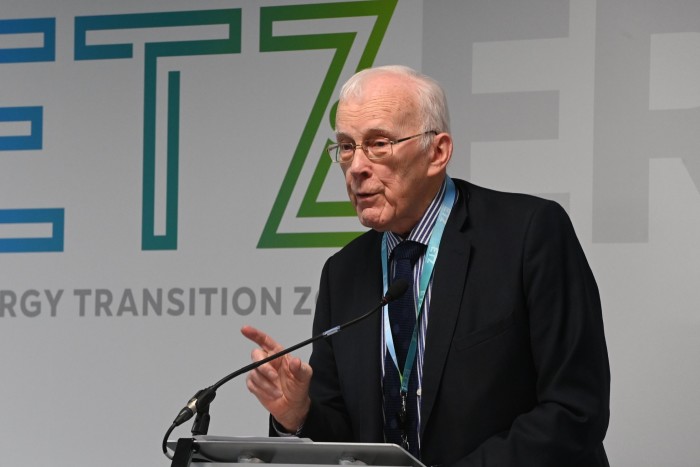
When he was young, Ian Wood made a bold move for his family’s company at the first Offshore Europe conference in Aberdeen back in 1973. His father, John, who ran their fishing business, was shocked by his son’s spending on marketing to tap into the emerging North Sea oil industry. Sir Ian, who received a knighthood in 1994, looks back on that time, recognizing the gamble he took ultimately paid off.
The offshore engineering branch of Wood Group, which split from the family business in 1982, gained a reputation as Aberdeen transitioned from a modest fishing port to a leading oil and gas center known for its global energy expertise. However, with the North Sea’s oil reserves dwindling, Wood Group has recently struggled under heavy debt burdens and poor financial results, reflecting the challenges faced by the city itself.
During its prime, Wood Group thrived as a key player in the North Sea development, forging partnerships with major oil companies like ExxonMobil and Chevron. At its height in 2018, the company was valued at £5.3 billion. Paul de Leeuw, from the Energy Transition Institute at Robert Gordon University, called Wood Group an “iconic company” with deep roots in Aberdeen.
Despite being a constant presence during the industry’s ups and downs, the company has faced dire times following a decade of global expansion that started after Sir Ian stepped down in 2012. This growth left Wood Group in a difficult position, struggling to manage its debts and facing staff losses due to cost-cutting measures. By February, its market value had plummeted by over 60 percent, reaching below £200 million, as it continued to face significant financial losses and governance issues.
Adding to its troubles, the chief financial officer Arvind Balan resigned after it was revealed he had misstated his professional qualifications. The company is now under interim leadership from Iain Torrens, a former executive from ICAP.
With $1.4 billion in debt to address by October 2026, Wood Group finds itself in a precarious situation. One industry expert described the company as being in a “death spiral,” noting that the leadership has been slow to acknowledge the extent of its challenges, causing more issues to arise.
In recent years, the company has also missed out on potential takeovers. Private equity firm Apollo had proposed a bid valued at about £2.2 billion, and Dubai-based Sidara attempted a $1.6 billion acquisition, both of which fell through. The second round of Sidara negotiations has begun, but it is expected that any deal will be for a much lower price.
Wood Group’s difficulties are reflective of broader issues facing its region. Entrepreneur Melfort Campbell highlighted that the company is emblematic of the decline in the North Sea, where its core operations have seen substantial reductions. Increased energy taxes have discouraged investment and raised concerns about a loss of skilled workers from Aberdeen’s corporate sector.
Recent legal setbacks for key UK oil and gas projects have exacerbated the situation, as the government must re-evaluate development proposals it previously approved. With thousands of employees based in Aberdeen, Wood Group represents a significant part of the local economy.
Residents of Aberdeen are feeling the impact, with a stagnant housing market and shuttered businesses highlighting a city struggling to benefit from a rise in oil prices. Sir Ian, now 82, remains active in the community, focusing on philanthropic endeavors related to education and innovations beyond oil.
In recent years, Wood Group shifted towards a more aggressive acquisition strategy, highlighted by its £2.2 billion purchase of Amec Foster Wheeler in 2017. While this move aimed to diversify into sectors like renewables, it came with increased legal risks and rising debt, complicating the company’s recovery.
Current chief executive Ken Gilmartin has promised a path to financial recovery by 2026, but skepticism remains among investors who have witnessed numerous setbacks. The discussions with Sidara are seen as crucial for Wood Group’s future, with both companies recognizing the potential of collaboration in the evolving energy sector.
Industry watchers in Aberdeen remain hopeful that Sidara could help revitalize Wood Group, which they deem vital to the local economy, as opportunities in offshore wind and carbon capture emerge. According to de Leeuw, the company serves as a barometer for the well-being of the oil and gas industry in the region – its fortunes effectively mirror those of the sector.