

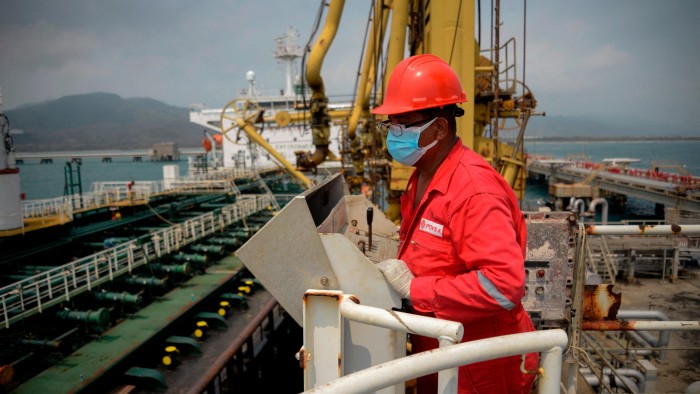
US President Donald Trump announced on Wednesday that he has canceled a concession agreement related to Venezuela’s energy sector, which previously allowed Chevron to operate and export oil from this sanctioned South American nation. This decision reverses the concessions made during Joe Biden’s administration in November 2022.
In a post on his Truth Social platform, Trump stated, “We are hereby reversing the concessions that Crooked Joe Biden gave to Nicolás Maduro on the oil transaction agreement… and also having to do with electoral conditions within Venezuela which have not been met by the Maduro regime.” The concessions aimed to encourage Maduro, the authoritarian president of Venezuela, to conduct free and fair elections.
Although Trump did not name Chevron specifically, it is the only company that received approval to work with Venezuela’s state-owned oil company, Petróleos de Venezuela (PDVSA), under the November 2022 agreement. Other companies such as Repsol, Eni, and Maurel & Prom have also received similar licenses.
Chevron responded by stating it is reviewing the implications of the cancellation, emphasizing its adherence to US laws and sanction frameworks while conducting business in Venezuela. Industry analysts warn that revoking Chevron’s license could severely impact Venezuela’s oil sector.
Schreiner Parker, an analyst from Rystad Energy, noted, “The loss of diluent supplied by Chevron is a major problem — it was a lifeline for their production.” Diluent helps to thin the heavy crude oil that Venezuela produces, making it essential for extraction and transport.
Parker also warned that Venezuela’s oil production could drop below 500,000 barrels per day, a significant decrease from just over 900,000 barrels per day in the previous year. Despite having the largest proven oil reserves in the world and being a founding member of OPEC, Venezuela’s oil production has declined from around 2.5 million barrels per day in 2016 to about 400,000 barrels per day by 2020, largely due to corruption, mismanagement, and sanctions led by the US. The production had seen some recovery last year, mainly due to Chevron’s joint venture.
Asdrúbal Oliveros from the consultancy Ecoanalitica estimated that the cancellation could lead to a reduction in GDP growth from 3.2% to 2% this year. He remarked, “Eliminating licenses has a significant impact not only on growth but also on foreign exchange flows, inflation, and devaluation.”
Despite international criticisms regarding the legitimacy of his presidency, Maduro was inaugurated for a third term in January. His main opponent from the last election, Edmundo González, has since gone into exile, while popular opposition leader María Corina Machado remains in hiding due to being banned from running.
Venezuela’s Vice President Delcy Rodríguez criticized Chevron’s license cancellation as “damaging and inexplicable.” Chevron has been actively lobbying to maintain its concessions in the country. CEO Mike Wirth had previously pointed out how the withdrawal of Western companies often opens doors for increased influence from nations like China and Russia.
In late January, Trump’s envoy, Richard Grenell, visited Caracas, meeting with Maduro to discuss a deal regarding deportees. The humanitarian crisis continues as over 7 million Venezuelans have fled the country in recent years due to economic difficulties and repression, while criminal organizations like the Tren de Aragua have expanded their operations internationally, including into the US.