

Is it better to address the symptoms or the root causes of a problem? Ideally, we would focus on the underlying issues. However, sometimes applying a quick fix is the only viable solution. This seems to be the approach BP’s CEO, Murray Auchincloss, may need to take as he prepares for the company’s capital markets day later this month.
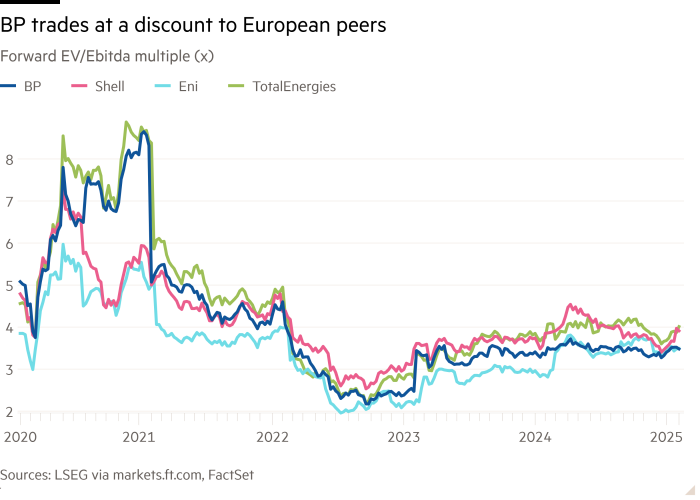
Unfortunately, enthusiasm for BP appears lacking. Over the past two years, the company’s share price has dropped by 25%, in contrast to Shell, which has seen a 4% increase, and TotalEnergies, which experienced a slight decline of 3%. BP’s enterprise value, measured against its projected earnings before interest, taxes, depreciation, and amortization (EBITDA), is currently at a notable 11% discount when compared to its European competitors.
To regain some investor confidence, Auchincloss must tackle two major concerns: the company’s net debt and its plans for share buybacks. BP’s net debt stands at around $50 billion, making it one of the highest leveraged companies among European energy firms. However, reducing this debt could conflict with the company’s goal of providing attractive returns to shareholders. Last year, BP pledged to repurchase up to $7 billion in shares for both 2024 and 2025, but with Brent crude prices falling more than 4%, analysts now expect this year’s buyback target to decrease to approximately $4 billion.
There are other short-term measures Auchincloss could consider, such as cutting capital expenditures, especially in clean energy and hydrogen sectors. BP anticipates spending between $14 billion and $18 billion annually until 2030. Recently, rival Equinor announced a significant reduction in its renewable investments, but BP’s ability to save on capital expenditures may be restricted due to the need for investment to stabilize oil production.
Despite potential short-term fixes, BP faces a more significant issue: a lack of investor confidence regarding its growth prospects over the coming decades. The ambitious energy transition strategy introduced by former CEO Bernard Looney in 2020 has already been scaled back, leading some analysts to question the quality of BP’s upstream assets.
As a result, BP is likely to be seen as a potential takeover target. Analysts suggest that UK competitor Shell could theoretically afford a 30% premium over BP’s current equity value if it manages to reduce its own administrative costs.
Although Auchincloss may manage to implement some strategies that could temporarily uplift BP’s stock price, a more profound transformation is necessary for the company’s long-term viability and attractiveness to potential buyers.