

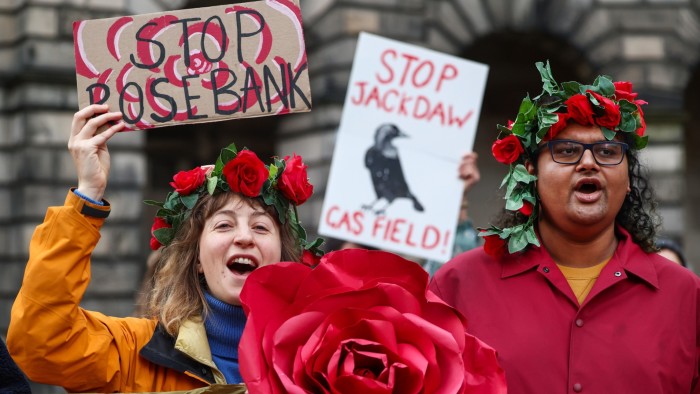
A significant setback has occurred in the UK’s fossil fuel industry, as a court has revoked permission for the exploration of one of the largest untapped oil reserves in the country. The decision affects the Rosebank oil field, located west of Shetland, which is estimated to hold around 500 million barrels of oil. Additionally, the ruling impacts another North Sea project.
On Thursday, Scotland’s highest civil court ruled against licenses that had been granted to Norway’s Equinor and the UK’s Ithaca Energy. This judgment also affects Shell, which is barred from producing gas at the Jackdaw field unless a new license is obtained.
The judge, Lord Ericht, acknowledged that the initial permissions were issued unlawfully based on a recent ruling by the UK Supreme Court, which emphasized the necessity of considering the impact of fossil fuel burning when granting licenses.
While the developers have already invested approximately £3 billion into these projects, they argued that their progress should allow them to proceed. However, Lord Ericht concluded that the public’s interest in ensuring legal compliance and addressing climate change outweighs the developers’ interests.
Equinor, Ithaca, and Shell may continue working on the project developments but cannot extract oil and gas while their license applications are reviewed by the North Sea Transition Authority. The NSTA, which had previously issued licenses for these projects in 2022 and 2023, must now assess the impact of emissions resulting from the use of the produced oil and gas in their evaluations.
The UK government’s Department for Energy Security and Net Zero is preparing new guidance to help consider environmental impacts in licensing, responding to calls for stricter oversight of fossil fuel projects.
In the political arena, the Labour Party has already stated in its election manifesto that it would not approve new exploration licenses, but would not prevent existing projects from moving forward. The licenses at stake are considered “consents to operate,” which differ from exploration licenses.
Both Equinor and Shell expressed determination to continue their development efforts, hopeful for a revised decision in favor of oil and gas production in the future.
Environment groups like Greenpeace and Uplift have challenged these projects, arguing that earlier approvals did not adequately consider emissions from the use of the extracted fossil fuels. Recently, the Labour government chose not to contest their legal challenge.
Philip Evans from Greenpeace hailed this ruling as a significant victory, while Tessa Khan of Uplift described it as crucial in ensuring that the climate impacts of the Rosebank project are thoroughly examined.
This court ruling stems from last year’s Supreme Court decision in the “Finch” case, which dealt with a proposed oil well in Surrey and highlighted the need to include downstream emissions in environmental impact assessments. Prior to this ruling, regulators had instructed Rosebank and Jackdaw developers not to factor these emissions into their plans.
Following the court’s decision, Equinor and Shell both expressed their willingness to work with regulators to advance their projects. They pointed out the importance of these developments for national energy goals.
Production levels in the North Sea have declined over recent years, with investors raising concerns about costs and increased taxes implemented in response to the energy price spikes following Russia’s invasion of Ukraine.