

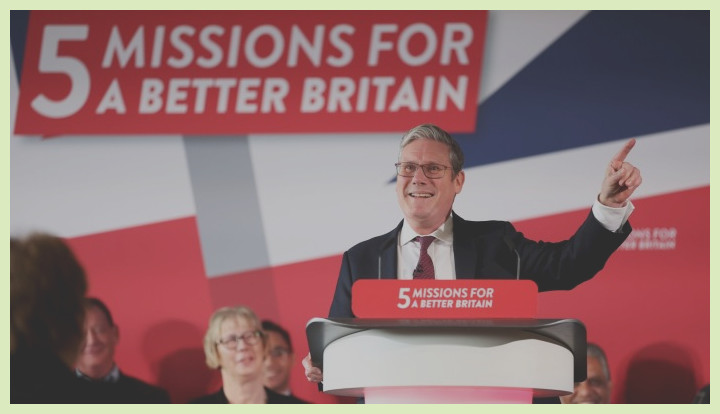
Sir Keir Starmer has made changes to his government’s green energy targets and revised his economic growth plans as he looks to refocus after a challenging start to his role as Prime Minister.
On Thursday, Starmer announced that the UK would now aim for at least 95% clean power by 2030, stepping back from a previous commitment to operate on “100% clean and cheap power” by that year. Despite this adjustment, he emphasized that his party’s green agenda, launched two years ago, remains unchanged.
During his address at Pinewood film studios near London, Starmer laid out new policy goals but did not specify a timeline for achieving the fastest growth in the G7, which was a prior promise. His revised goals include increasing real disposable income and GDP per capita by the end of his term, which could extend until 2029.
Starmer’s team clarified that this address was not a complete rebranding but rather an effort to clearly outline his administration’s key priorities, which include economic growth, clean energy, strengthening the NHS, enhancing public safety, and improving education standards.
Acknowledging a drop in his approval ratings since Labour’s major victory earlier this year, Starmer stated that his “Plan for Change” would arrive on civil servants’ desks “with the heavy thud of a gauntlet being thrown down.” He expressed his desire to utilize the government’s full capabilities to achieve these objectives but acknowledged that the current system is in need of modernization, including greater use of artificial intelligence.
In response to criticism over an overwhelming number of initiatives, Starmer pointed out that many of his previous policy promises were not clearly understood by voters. His updated economic goals highlight a commitment to raising living standards across the UK, ensuring that working individuals have more financial means.
In addition, he has set targets for constructing 1.5 million homes in England and expedited over 150 major infrastructure projects, stating that these elements are essential for fostering higher growth.
Regarding the NHS, Starmer pledged that 92% of patients would wait no longer than 18 weeks for elective procedures. He also committed to increasing the number of police officers and ensuring that a significant percentage of children reach school prepared to learn.
Starmer reiterated that the alteration in language around green energy would not impact Labour’s commitment to achieving zero-carbon electricity by 2030. He noted that the definition of “clean power” includes maintaining a strategic reserve of gas power stations for energy security.
Critics from the Conservative Party, including shadow energy secretary Claire Coutinho, have argued that Labour has diluted its plans due to the potential costs involved. However, Chris Stark, who leads the UK’s clean power mission, asserted that the policy stays consistent with initial promises and that the expert definition aligns with the revised targets.