

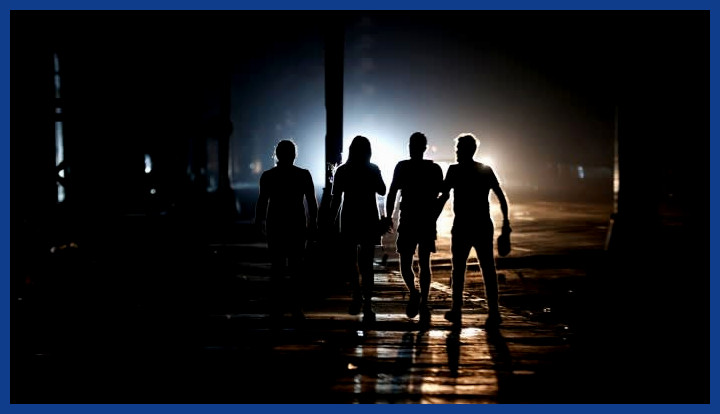
Cuba’s communist regime finds itself grappling with an unprecedented crisis—the harshest trials since the seismic upheaval surrounding the Soviet Union’s dissolution in 1991. The embattled nation confronts relentless power outages that have plunged the island into darkness, exacerbating already dire shortages of food, fuel, and medicine.
In a staggering blow to daily life, the national grid faltered not once, but four times in a mere four days, leaving swathes of the populace—Havana included—thrust into the gloom of a power-less existence. Residents now find themselves engaging in a laborious ritual, lugging buckets of water from distant cisterns or wells, and standing in ever-lengthening lines for the most basic of provisions, like bread.
Amidst this turmoil, small anti-government demonstrations erupted over the weekend across the island. In a bid to quell dissent, President Miguel Díaz-Canel made a rare television appearance adorned in military fatigues, sternly admonishing Cubans against acts of “vandalism.”
“We shall not stand idly by as havoc unfolds; neither shall we permit anyone to disturb the peace of our citizenry,” declared the president, his military garb a stark deviation from his usual attire.
In a further effort to restore order, authorities shuttered schools and non-essential businesses on Monday, scrambling to reconnect the broken power grid. By the afternoon, however, state media reported a gradual recovery, noting that approximately 89 percent of Havana’s populace regained electricity, though rural regions lagged behind in the recovery.
As this energy crisis erupted on Sunday, mother nature added insult to injury—hurricane conditions of category one twisted through the eastern parts of the island, unleashing heavy rains and fierce winds, compounding the struggle for recovery.
The crisis could not have come at a more precarious juncture for Cuba, a nation grappling to provide its citizens with essentials—food, potable water, and waste management—while grappling with an unyielding drop in tourist income and the weight of severe US sanctions.
“The Cuban government and Communist Party are entrenched in the gravest crisis since the Soviet Union’s collapse, besieged both economically and politically,” remarked Bill LeoGrande, a Cuba expert from American University in Washington, D.C. “The finances are in disarray; they lack the funds necessary to import sufficient quantities of food and fuel.”
Cubans have adapted to intermittent power loss, but the current outages have intensified, with commonplace four-hour blackouts in urban centers, while rural areas endure privations stretching beyond twelve hours.
In a recent televised address, Prime Minister Manuel Marrero starkly acknowledged that the nation can no longer procure enough fuel from international markets to sustain its energy needs.
Aid from Cuba’s international partners fails to bridge the widening gap. Though Venezuela has long provided a lifeline, its oil shipments have dwindled significantly. Meanwhile, while Russian crude supplies have increased, they fall short of meeting Cuba’s insatiable energy demands. Though China is investing in solar technology on the island, such developments are still years away from fruition.
Meanwhile, the government’s neglect of aging Soviet-era power plants and its hesitance to fully embrace promised economic reforms have inhibited any meaningful transition toward a more viable market economy.
The US embargo looms large, complicating the scenario with its stringent restrictions. The Biden administration has upheld what is termed “maximum pressure” sanctions from the Trump era, stifling potential revenue streams—an estimated loss of billions of dollars annually for state finances.
“This reinforced embargo systematically undermines Cuba’s capacity to import essential spare parts and fuel crucial for electricity generation,” noted Fulton Armstrong, a former US national intelligence officer for Latin America.
Analysts agree that for Cuba to realize a more durable energy framework, it must undertake a radical transformation of its antiquated Soviet-era power infrastructure, many components of which are teetering on the brink of obsolescence.
“The solution lies in sweeping reforms paired with external investment,” asserted Ricardo Torres, a research fellow at the Center for Latin American and Latino Studies at American University.