

Greece is stepping up to be a key player in Europe’s energy scene, aiming to become the primary entry point for liquefied natural gas (LNG) imports. This shift comes as the European Union prepares to stop all gas supplies from Russia by 2027.
By leveraging its geographical position, enhanced LNG facilities, and strong relations with the US, Greece sees an opportunity to play a major role in Europe’s gas market post-Russia. Before Russia’s invasion of Ukraine, they supplied about 40% of the EU’s gas; this figure plummeted to around 11% by 2024, largely replaced by US LNG, which now makes up nearly 60% of EU’s imports.
Stavros Papastavrou, Greece’s energy minister, emphasized in a recent interview that the nation is committed to reducing reliance on Russian energy. He stated, “We are no longer going to fund the attacker,” adding that more efforts are necessary to completely eliminate Russian fossil fuels.
Since 2025, Papastavrou has prioritized strengthening ties with the United States, framing energy cooperation as a vital aspect of transatlantic relations amid rising tensions in Europe. The emergency LNG deliveries from the US following the onset of the war in Ukraine have now transitioned into a strategic, long-term realignment of energy supplies for the EU.
In addition, the EU has significantly reduced its oil imports from Russia. Greek ships still transport Russian oil, but only when market conditions allow compliance with price caps imposed by allies of Ukraine.
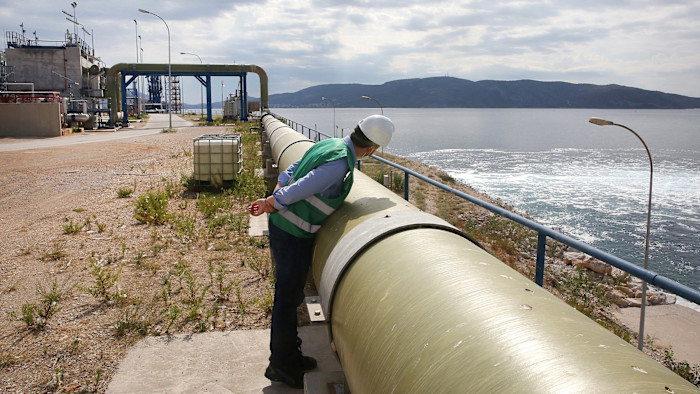
Greece’s plan to become a central hub for US gas is evident at Revithoussa, its main LNG terminal. Recently, an American LNG cargo was being unloaded there, showcasing its role in the evolving energy landscape.
From Revithoussa, the re-gasified LNG is distributed northward through a system called the “vertical corridor,” linking Greece with Bulgaria, Romania, Moldova, and Ukraine. This infrastructure was developed after Russia suspended gas supplies to Bulgaria in 2022. While the vertical corridor largely utilizes existing structures, Bulgaria is investing €400 million to eliminate bottlenecks by 2027.
Maria Rita Galli, the former CEO of Greece’s gas grid operator, noted that Greece was already diversifying its energy sources before the war, thanks in part to the TAP gas pipeline completed in 2020, which connects the Greek-Turkish border to Italy via Albania.
Despite the rapid changes, there are still uncertainties regarding demand in the vertical corridor. Pipeline bottlenecks need resolving, and EU regulations must align to facilitate long-term bookings. However, interest for future bookings is on the rise, with companies already securing slots at Revithoussa through to 2040. Galli remarked that this year’s market activity reflects a renewed recognition of Greece as a strategic entry point.
Challenges like high tariffs remain. Julian Bowden from the Oxford Institute for Energy Studies pointed out that the combined costs for transporting gas through Greece and neighboring countries are currently too high for a long-term viable route.
Papastavrou is set to meet with energy ministers from the vertical corridor nations and US officials to further discuss these developments, signifying the increasing attention on this region.
Though US LNG is more expensive than Russian pipeline gas, critics warn that Europe might be exchanging one geopolitical risk for another, as over 80% of Greece’s LNG imports could come from the US by 2025. However, Bowden highlighted that the dispersed nature of US gas exports reduces the potential for political manipulation, unlike supply from Russia.
The evolving dynamics in European energy markets emphasize the importance of strategic planning and collaboration in ensuring secure and diversified energy supplies.