

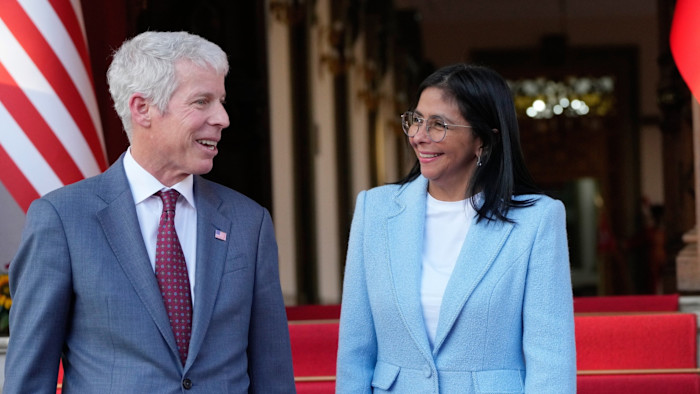
U.S. Energy Secretary Chris Wright recently expressed strong interest in seeing a surge of investments in Venezuela during a meeting with the country’s interim president, Delcy Rodríguez, in Caracas. During a roundtable discussion, he emphasized that American companies are increasingly keen to explore business opportunities there.
Despite the enthusiasm, Wright clarified that the U.S. government would not provide the security or financial guarantees that oil executives are seeking for investments in Venezuela. He noted that this visit marked the first time a high-ranking U.S. official had traveled to Venezuela since the arrest of the controversial leader Nicolás Maduro.
Many U.S. companies have been hesitant to invest, with ExxonMobil’s CEO, Darren Woods, even labeling Venezuela as “uninvestable.” Nevertheless, Wright remains optimistic, stating that he believes the country can transition from a high-risk investment environment to a more secure one as businesses reassess their strategies.
Venezuela is rich in oil reserves, boasting the largest proven reserves globally. Yet, relations with the U.S. have deteriorated since Hugo Chávez became president in 1999, forming ties with nations like Russia and China. Wright voiced concerns about the nature of some Chinese investments in Venezuela, suggesting that they are often not mutually beneficial.
Since Maduro’s presidency began amid significant economic turmoil, the U.S. has implemented sanctions against the Venezuelan state oil company, PDVSA. However, following actions against Maduro and his wife, the U.S. has started easing some of these restrictions, allowing certain oilfield services to operate in Venezuela.
Wright mentioned that the U.S. is dedicated to issuing licenses for companies looking to work in Venezuela, underlining a commitment to supporting the Venezuelan people and economy. However, he also indicated that there isn’t a definitive timeline for lifting all sanctions.
Rodríguez, who once served as Maduro’s vice-president, highlighted her administration’s efforts to bridge diplomatic gaps, aiming for reforms that encourage investment in the oil sector. She was optimistic about future relations, though she noted that she has significant work to do in Venezuela before considering a trip to Washington.