

The International Energy Agency (IEA) has reported a significant slowdown in oil demand growth for this year. In their latest forecast, they predict that demand will rise by only 730,000 barrels per day (b/d), a reduction of about one-third from their earlier estimate of 1.03 million b/d. This revision was largely prompted by the negative effects of tariffs imposed by the United States on trade.
According to the IEA, around half of the expected decline, which amounts to 300,000 b/d, is anticipated to come from reduced demand in the US and China. The agency explained that while oil, gas, and refined products were initially exempt from the tariffs, the overall economic implications, such as inflation and slowed growth, have affected oil prices.
The IEA’s assessment arrives at a time when traders are attempting to gauge the long-term repercussions of sweeping tariffs introduced by President Trump on all major trading partners. These tariffs were put in place on April 2, but were temporarily paused a week later amid market instability.
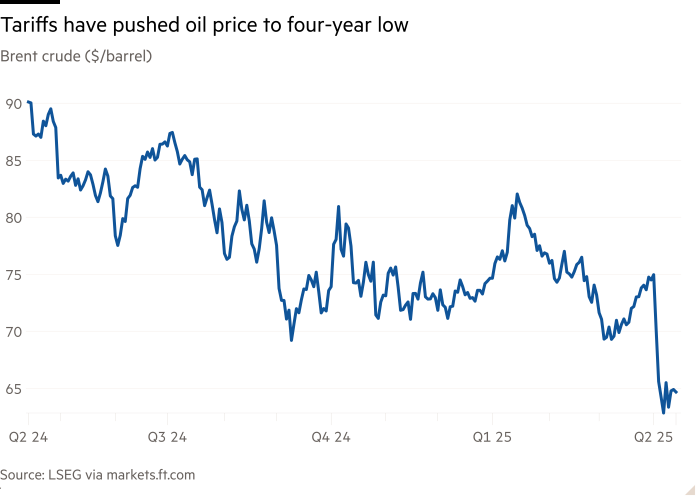
In response to the shifting market conditions, prices for Brent crude dropped below $60 per barrel for the first time in four years. This decline was a reflection of fears regarding a potential global recession, a concern that eased when Trump decided to suspend most tariffs for a 90-day period while negotiations continue.
Although the pause in tariffs has mitigated some recession fears, Trump has increased retaliatory tariffs on China to 125%, intensifying the trade conflict with the country.
As a result of these rising trade tensions, the IEA has revised its growth outlook. They now predict global GDP growth to be around 2.4% for this year and 2.5% in 2026, down from earlier projections of 3.1%.
The IEA also indicated that expected annual demand growth could decline further next year to 690,000 b/d, reflecting the impact of a weaker economic climate. Meanwhile, the oil-producing group OPEC+ announced plans to roll back supply cuts sooner than anticipated, further contributing to the downward trend in oil prices.
OPEC also adjusted its oil demand forecast for 2025, reducing it by 100,000 b/d while expecting global demand to increase by 1.3 million b/d in 2023.
The Trump administration aims to boost US oil and gas production by 3 million barrels a day by 2028; however, the recent drop in prices may impede this growth. Many US shale producers need an average price of at least $65 per barrel to justify new drilling projects, leading to a revised forecast for US production growth down to 490,000 b/d.
Overall, global oil production is expected to grow by 1.2 million b/d this year, down from an earlier estimate of 1.46 million b/d, reflecting a slowdown in US shale production and fewer supplies from Venezuela due to stricter US sanctions.