

The Trump administration is working on an executive order that aims to boost US self-sufficiency in essential minerals by allowing the stockpiling of metals found on the seabed of the Pacific Ocean. This move is seen as a way to reduce China’s control over key battery and rare earth mineral supply chains.
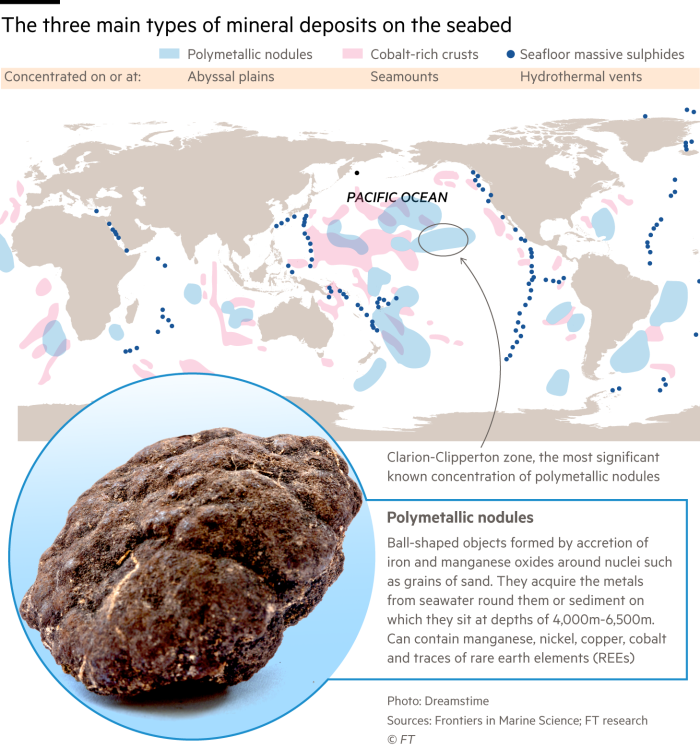
These valuable potato-sized nodules form on the ocean floor over millions of years under extreme pressure. They are rich in nickel, cobalt, copper, and manganese, all critical for making batteries and electrical wiring, plus some rare earth elements.
With an eye on becoming more independent in these crucial materials, the US has been making various efforts, including encouraging Ukraine to negotiate mineral deals and even suggesting the acquisition of Greenland.
Alexander Gray, an expert on Asia and a former chief of staff to the US national security adviser during Trump’s first term, emphasized the importance of focusing on deep-sea mining. He noted that China sees the deep sea as an arena for competing with the US economically and militarily.
Gray stated, “As the Trump administration has done with shipbuilding and critical minerals more broadly, it is vital for the US government to concentrate on areas that pose a significant risk due to China’s ambitions.”
A strategic reserve of these seabed-derived polymetallic nodules could assist the US in catching up with China in the global race for deep-sea resource exploration. Recently, China implemented export restrictions on certain rare earth elements, indicating its intent to use these resources as a tool for economic leverage.
The administration seeks to accelerate deep-sea mining applications and establish domestic processing facilities for the nodules. Prominent Republicans, such as Secretary of State Marco Rubio and National Security Adviser Mike Waltz, have been vocal supporters of this initiative, highlighting that the defense budget has already mandated a study on the feasibility of refining these nodules for defense purposes.
A congressional aide conveyed that “this is no longer just a commercial issue.” The growing capability of China in this sector poses a potential threat, making it essential to stockpile these resources on US soil for future use, especially in light of possible conflicts that could hinder imports.
Despite significant support from Republican leaders for seabed exploration, the US remains mostly absent from international talks regarding seabed mining and has yet to ratify the United Nations Convention on the Law of the Sea, which sets the legal framework for these activities.
Recent discussions at the International Seabed Authority in Jamaica concluded without any agreement to commence mining in international waters, as many countries continue to call for a moratorium on this practice. Critics argue that seabed mining could jeopardize fragile marine ecosystems and are concerned that the US could struggle to replicate China’s extensive supply chain at competitive prices.
The Metals Company, based in Vancouver, is leading efforts to advance seabed exploration, with its US subsidiary moving to apply for permits under a 1980 US law. The CEO stated that the International Seabed Authority does not hold exclusive authority to manage resources in international waters.
Jose Fernandez, a former economic envoy under President Biden, warned companies to exercise caution and consider the potential legal implications of proceeding without proper permits, emphasizing that existing treaties restrict jurisdiction.
As of now, the Commerce Department has not commented on the situation, and the White House National Security Council has also refrained from providing remarks.