

In recent developments, President Donald Trump announced a temporary 90-day halt on additional tariffs for countries willing to negotiate with the US. This news positively impacted the stock market, yet oil prices continued to exhibit volatility.
On a recent Wednesday, the international oil benchmark, Brent crude, saw a rise, settling at $65.48 per barrel. This improvement came after falling below the $60 mark for the first time in four years, prior to Trump’s tariff announcement. Despite this recovery, crude oil prices have significantly declined throughout the year. Reports indicate that shale producers are encountering some of the toughest challenges they’ve faced in years due to the potential impacts of these tariffs.
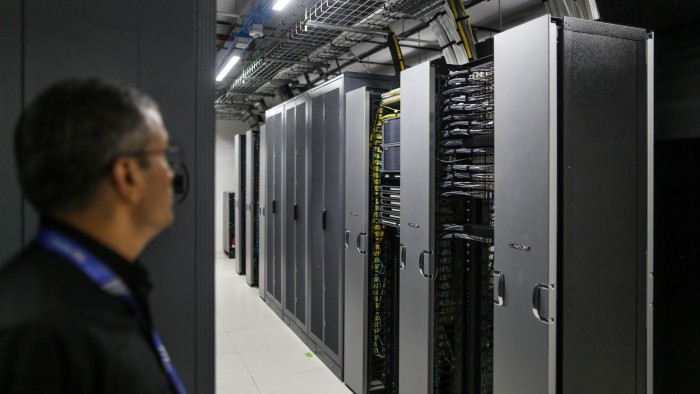
Today, we dive into the pressing issues surrounding the aging US power grid and supply chain constraints, which could potentially hinder the expansion of data centers across the country. This situation complicates the efforts of Washington to maintain its lead in artificial intelligence.
Is the US Power Grid Prepared for Data Center Demands?
To stay competitive in the artificial intelligence sector, the United States needs to significantly increase the number of data centers nationwide. However, experts are raising alarms over whether the aging power grids and existing supply chain limitations can handle this growth.
Utility companies are under pressure like never before, receiving an unprecedented number of requests for new power capacity from data center operators. For instance, Sempra’s Texas utility, Oncor Electric, reported requests to add approximately 119 gigawatts of new load to the grid from data centers last year.
Chris Seiple, a vice-chair at Wood Mackenzie, emphasized that the limited capacity of the US power grid could slow down the rollout of new data centers. “The extent of data center capacity added in the next five years will heavily depend on how much energy we can actually integrate into the grid,” he said.
This issue extends globally. A new report from the International Energy Agency (IEA) finds that grid constraints might delay around 20% of the data center capacity planned for construction worldwide by 2030.
In the US, energy demands have surged after two decades of stagnation, making the situation even more critical. While the IEA predicts that the future electricity demand from data centers will be relatively small, the strain they place on grid operators could be significant, as these AI-driven facilities often require more energy than traditional ones.
Jim Robb, CEO of the North American Electric Reliability Corporation, compared the demand for certain data centers to the energy needs of a city, highlighting the challenges in building both generation and delivery infrastructure.
Moreover, the power grid is also experiencing increased energy demands linked to the electrification of transport and the reshoring of manufacturing. However, AI technologies pose unique challenges due to their heightened energy needs and the requisite upgrades to infrastructure to meet the demands of large-scale data centers. Notably, while many data centers prioritize renewable energy, this alone isn’t sufficient to meet the current energy demands, necessitating the building of more natural gas-fired power plants.
Seiple pointed out that the construction of new combined cycle power plants has grown expensive, with average costs now exceeding $2,000 per kilowatt, doubling since the pandemic started.
Renewable sources such as wind and solar additionally require enhanced transmission lines to convey energy effectively. However, multi-state transmission projects often take 15 to 17 years to complete, which Robb insists must be expedited to just three to five years.
Compounding these issues, crucial components needed for grid infrastructure, including transformers and gas turbines, are facing supply chain delays. Seiple mentions that lead times for transformers, essential to transmission, have tripled since 2021.
The recent wave of tariffs could further exacerbate supply chain challenges, increasing costs related to infrastructure. Karen Wayland, CEO of GridWise Alliance, has cautioned that these tariffs will likely inflate grid project expenses and complicate future investment decisions for businesses.
For utilities, uncertainty looms as they navigate the unpredictable demand from data centers. Seiple mentioned that utilities have never experienced so many risks associated with prospective customers. With the surge in power demand obvious but the exact figures unclear, planning becomes increasingly complex.
Some experts suggest that predictions regarding the energy demands of data centers might be exaggerated. An Energy Intelligence report highlights instances where AI systems, such as those developed by Nvidia, have drastically improved energy efficiency, indicating that the sector could require less power than anticipated.
Earlier this year, a Chinese AI startup claimed to accomplish similar tasks using much less energy compared to US counterparts, raising the question of whether data centers need as much power as forecasted. Nonetheless, system operators are still observing a rise in demand from data facilities.
Dominion Energy indicated a doubling in its data center customer inquiries since July, and Duke Energy has noted no decline in electricity demands related to generative AI.
Job Moves
- Energy Vault has added Dylan Hixon to its board of directors.
- Xstate Resources appointed Andrew Bald as its managing director, transitioning Andrew Childs to a non-executive role.
- ENRG Elements has appointed Paul Ingram as its non-executive chair.
Power Points
- The US has revoked licenses for BP and Shell’s gas projects in Venezuelan waters, potentially putting a vital liquefied natural gas project in Trinidad and Tobago at risk.
- Mitsui OSK Lines, a Japanese shipping company, has criticized rival AP Møller-Maersk’s proposals to impose higher regulatory costs on LNG as opposed to zero-carbon fuels for shipping.
- The global demand for nuclear energy is skyrocketing, necessitating immediate, significant investment in uranium mining, according to the latest industry reports.
This newsletter is crafted with insights and updates from the Energy Source team, ensuring you stay informed on pivotal energy developments.