

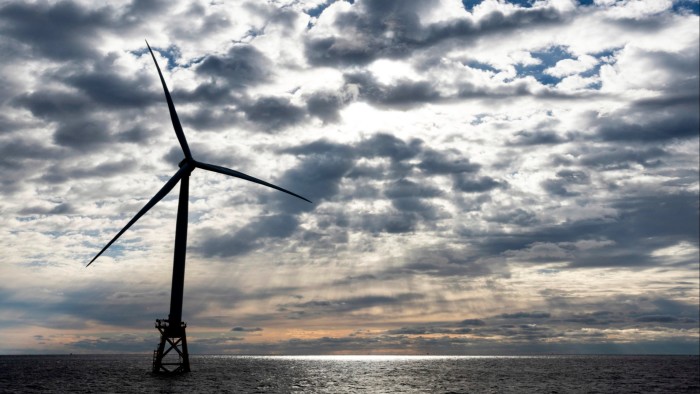
Donald Trump’s decision to suspend permits for offshore wind development has had a harmful impact on an industry already facing challenges. Industry leaders are warning that this could jeopardize America’s energy supply and plans to reduce carbon emissions.
According to consultancy Rystad Energy, over 90% of proposed offshore wind projects in the U.S., which amounts to more than 60 gigawatts, are now at significant risk. In comparison, the United Kingdom boasts 14 gigawatts of offshore wind capacity, while the U.S. has less than a quarter of a gigawatt. Unlike other renewable energy sectors, U.S. offshore wind development depends heavily on federal government approvals for permits.
Artem Abramov, who leads clean tech efforts at Rystad, stated, “Trump has significantly harmed the industry.”
On his first day in office, Trump halted leases and permits for offshore wind projects and called for reviews of projects that were already approved. His recent re-election has caused unease throughout the industry, leading many developers to either scale back or abandon their U.S. projects. For instance, Vineyard Offshore, a developer supported by Copenhagen Infrastructure Partners, recently cut 50 jobs due to “recent market uncertainties.”
The U.S. offshore wind sector has endured over two years of high interest rates and inflation, leading to numerous contract cancellations and renegotiations. Ørsted, the largest wind developer, referred to its U.S. projects as the “most painful” part of its portfolio this year.
Last month, Shell withdrew from the only federally approved offshore wind project in New Jersey, incurring nearly $1 billion in losses just days after Trump remarked that he hoped the project was “dead and gone.” Similarly, TotalEnergies announced it would not pursue U.S. offshore wind projects for the next four years.
Industry professionals are particularly concerned about how Trump’s pause on offshore wind projects will affect clean energy initiatives and grid reliability along the U.S. East Coast, especially as demand for electricity grows from data centers and electric vehicle charging stations.
Hillary Bright, executive director of Turn Forward, a non-profit organization that advocates for offshore wind, remarked, “It’s becoming increasingly difficult to generate electricity through other means. If we lose this development, where will our energy come from?”
Robert Blue, the head of Dominion Energy, which is building the largest offshore wind project in the country, cautioned that halting development could be the “most inflationary action” for Virginia’s energy sector.
Developers have expressed that Trump’s decision sends a concerning message regarding the stability of investment in the United States. According to Oceantic Network, a non-profit, over $40 billion has already been invested in the U.S. offshore wind sector. A consultancy, BloombergNEF, estimates that more than half of the advanced offshore wind projects in the U.S. are backed by European firms.
Despite federal subsidies, offshore wind remains one of the priciest sources of electricity in the U.S., costing between $74 and $139 per megawatt-hour, in contrast to $45 to $108 per megawatt-hour for gas-fired plants, as reported by Lazard’s Levelized Cost of Energy.
Several executives have noted that economic factors, rather than policy, are driving decisions to delay or prioritize other energy sources.
Brian Savoy, chief financial officer at Duke Energy, mentioned their minimal progress on a lease obtained in a 2022 auction off North Carolina’s coast, stating they need “clarity” before proceeding further.
Patricia Poppe, CEO of Pacific Gas and Electric, the largest utility in the country, indicated that the company has “no plans” to develop offshore wind, preferring lower-cost alternatives for meeting customer demand.
Scott Strazik, chief executive of GE Vernova, the leading manufacturer of wind turbines in the U.S., noted that Trump’s actions won’t change their expectations of growth, emphasizing the need for more favorable economic conditions before they can consider new offshore wind orders.