

In this week’s Energy Source newsletter, we explore the implications of U.S. President Donald Trump’s ongoing trade tensions, particularly focusing on how these conflicts may influence energy exchanges between the United States and Canada, as well as with India.
Following a recent meeting between Trump and Indian Prime Minister Narendra Modi, the two leaders expressed intentions to increase India’s imports of U.S. oil and gas. While specifics remained sparse, analysts suggest that liquefied natural gas (LNG) will likely dominate this trade, as it becomes a strategic element in negotiations.
Helima Croft, a prominent analyst at RBC Capital Markets, remarked that LNG is emerging as a crucial bargaining chip in efforts to avoid tariffs. Notably, India’s oil and gas minister, Hardeep Singh Puri, indicated readiness to expand gas imports from a variety of sources, clearly aligned with U.S. expectations.
In response to these developments, we turn our attention to Canada. Ilya Gridneff, our correspondent based in Canada, presents an insightful analysis of how Trump’s aggressive trade policies are fostering a nationalistic sentiment, urging Canada to assert itself as an “energy superpower.” This ambition is driven by the nation’s substantial oil reserves and its pivotal role as the largest foreign supplier of oil to the U.S., contributing nearly 60% of total imports.
Despite historical challenges in pipeline development, there is renewed discussion around potentially reviving projects such as Energy East and Northern Gateway. These initiatives could diversify Canada’s oil economy, aiming to establish new trading relationships beyond U.S. borders. Alberta’s Premier Danielle Smith has indicated that new pipeline projects could enable Canada to double its oil output, presenting a countermeasure to the heightened trade tensions.
Political dynamics are also shifting, with Canadian policymakers reassessing the country’s dependency on the U.S. for oil exports. Natural Resources Minister Jonathan Wilkinson acknowledged the need for diversification, hinting at the potential for new east-west oil pipelines.
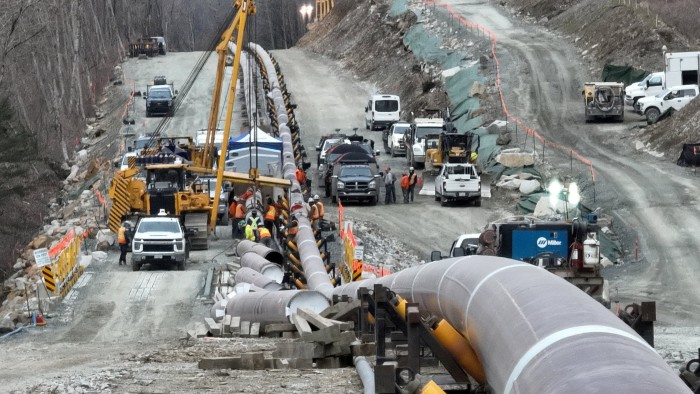
However, pipeline construction in Canada faces significant hurdles, including lengthy regulatory processes, community opposition, and environmental concerns. The recent Trans Mountain Expansion pipeline, which has faced over a decade of delays, underscores the complexities involved in such large-scale projects.
Shifting public attitudes further complicate the landscape. Recent polls indicate that Canadians are increasingly prioritizing economic growth over climate issues in energy policy discussions—a notable change from previous sentiments.
As the country prepares for the upcoming elections, energy remains a critical topic. With political contenders like Chrystia Freeland and Mark Carney presenting differing visions for Canada’s energy future, the conversation around energy policy will undoubtedly remain vibrant and dynamic.
In summary, Canada is leveraging its energy resources as a potential counter to trade tensions, with a growing focus on refining its energy policies to adapt to the changing global landscape. The nation’s response illustrates how energy can serve as both a strategic asset and a catalyst for economic resilience in the face of international challenges.