

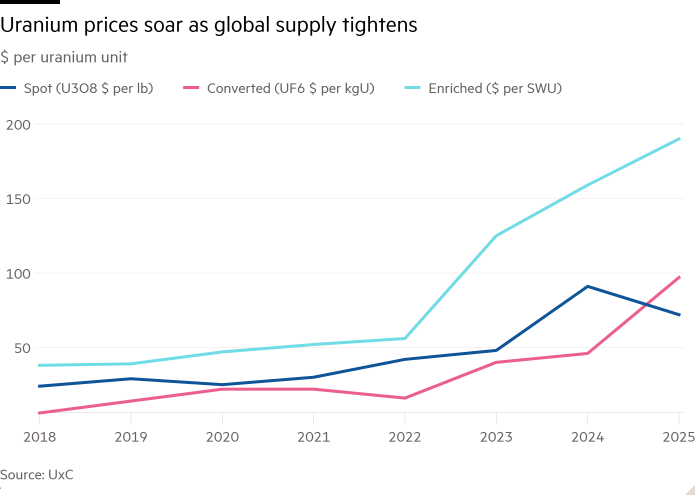
The cost of fuel for nuclear reactors has reached new heights, largely due to the rising demand from artificial intelligence data centers. This surge in prices follows the disruptions in the market created by Russia’s invasion of Ukraine.
Enriched uranium prices have climbed to an unprecedented $190 per separative work unit, which measures the effort needed to separate uranium isotopes. Just three years ago, the price was only $56, according to UxC data.
Interest in nuclear energy is growing as governments and companies look for carbon-free power sources that can adequately support large industries and communities. Major technology firms like Microsoft and Amazon are now keen on using this nuclear fuel to power their extensive data centers, essential for their competitive edge in the rapidly growing AI sector.
The competition for energy resources has intensified since Russia’s invasion of Ukraine nearly three years ago. Russia plays a significant role in the enrichment of uranium, but recent U.S. sanctions and Russia’s export bans have contributed to the soaring prices.
Nick Lawson, the CEO of investment firm Ocean Wall, noted that the West is struggling with a lack of uranium conversion and enrichment capacity, leading to the recent price increases. He predicts prices will continue to rise.
Experts point out that the problem could become even more challenging when a U.S. waiver for uranium imports expires at the end of 2027. This situation is pushing the industry to search for new facilities capable of converting uranium into the necessary pellets for nuclear reactors. The main Western countries that currently have operational uranium conversion plants are France, the U.S., and Canada.
Lawson highlighted the importance of making substantial political decisions regarding the nuclear and uranium supply chain, noting that building new facilities requires significant investment and many years.
As of 2023, about 27% of U.S. enriched uranium imports came from Russia. Analysts from Berenberg indicate that while U.S. utilities may have sufficient fuel for this year, their supplies could dwindle significantly in the coming years.
They emphasize that U.S. utilities need to start discussions this year to secure uranium supplies, especially with restrictions on Russian imports coming into effect by the end of 2027.
Most uranium is traded through long-term contracts, rather than on the spot market. However, industry analysts warn that immediate delivery prices could rise due to potential shortages. Kazatomprom, Kazakhstan’s state-owned uranium producer and the largest globally, has recently indicated lower-than-expected production levels.
Andre Liebenberg, CEO of Yellow Cake, a uranium investment firm, mentioned that Kazakh uranium may increasingly head to China and Russia instead of Western nations, which could cause issues for U.S. utilities. He cautions that without new projects coming online soon, there could be a significant supply crunch in the medium term.