

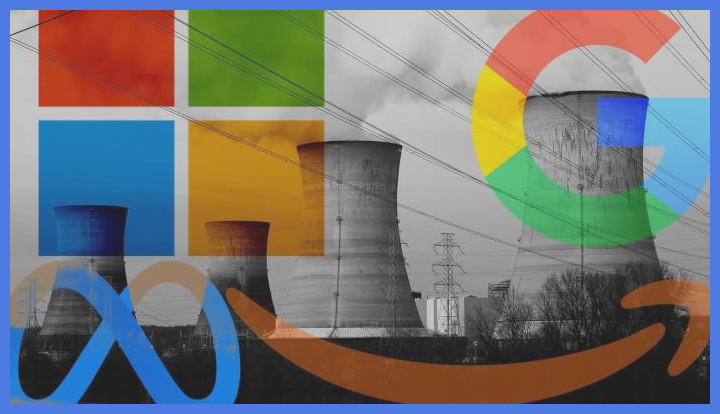
The burgeoning demand for artificial intelligence (AI) and its relentless thirst for electricity has serendipitously aligned with a resurgence of interest in nuclear energy. After enduring years of stagnation in Western nations, a remarkable uptick in nuclear plant requests has emerged this year, largely driven by hyperscale technology giants—think of industry titans like Google, Amazon, Meta, and Microsoft. They require staggering amounts of low-carbon power, available around the clock, to fuel their expansive data centers and secure what has been internally dubbed “the AI war.”
At a climate event in New York last week, some of the largest banking institutions publicly rallied behind the nuclear sector. This demonstration of endorsement is crucial as the industry attempts to position itself as an essential lifeline in the transition towards cleaner energy.
Yann LeCun, Meta’s chief AI scientist, articulated the vision succinctly on social media: AI data centers must be colocated with energy production facilities capable of generating gigawatt-scale, low-cost, low-emission electricity—essentially, nuclear power plants. Chris Rees, energy strategy manager at Meta, hinted at the clandestine fervor lurking behind corporate walls: “There’s a genuine appetite,” he shared, “It’s all there; while we can’t delve too deeply, it’s clear that every major player is intrigued.”
A palpable excitement has gripped the nuclear industry. In contrast to nations like China and South Korea, which have been diligently erecting new reactors over recent decades, the United States and Europe have seen a notable decline. Following a major wave of nuclear power station construction during the 1970s and 1980s, the U.S. has only witnessed the addition of three new reactors since the mid-1990s, as escalating costs and public fear—stemming from disasters like Three Mile Island, Chernobyl, and Fukushima—have stunted growth.
Recently, Microsoft made waves by announcing the revival of the defunct Three Mile Island nuclear plant in Pennsylvania. Concurrently, Amazon forged a deal amounting to $650 million to situate a data center adjacent to the Susquehanna Steam Electric nuclear plant, also in Pennsylvania. Such premium expenditures by tech firms could usher in a torrent of investment towards new nuclear facilities, according to industry analysts.
“The market is reaching price points that could validate new construction,” remarked Arthur Hyde from Segra Capital, a hedge fund invested in uranium supply chains. The convergence of government pledges for nuclear investment, financial assurances, and surging demand sets the stage for revitalizing the nuclear landscape in the U.S. and Europe. “For the first time, we’re witnessing the synthesis of all these crucial elements,” he commented with optimism, predicting new nuclear capacity announcements in the next year.
Yet, beneath the surface of enthusiasm lies a mire of structural challenges. The pivotal question looms: Who will shoulder the substantial risks associated with nuclear projects—often known for their protracted timelines and costly overruns? An insider from a leading tech firm was candid: “Tech companies aren’t in the business of owning a nuclear asset. It would be a strategic blunder.” During a nuclear industry gathering just before New York’s Climate Week, Caroline Golin from Google emphasized that tech firms cannot be expected to absorb all the project risks, as corroborated by anonymous attendees.
At the World Nuclear Symposium held in London, Todd Noe from Microsoft echoed similar sentiments, suggesting the utmost contribution tech companies are prepared to make involves guaranteeing long-term power purchase agreements (PPAs) that offer reasonable prices for energy. Yet, this might not suffice. “They engage with us, with nuclear tech providers, and utilities, yet their aim remains fixed on being end users, not operators of reactors,” remarked Ahmet Tokpinar, head of nuclear power at Bechtel, a major U.S. engineering firm. He warned that while discussions around equity investment in projects exist, they have yet to materialize.
For new plants to break ground, substantial capital infusion from tech firms is paramount; without it, the dream remains as elusive as ever. The need for clarity on who will underwrite the risk grows increasingly urgent. Microsoft, Amazon, and Google chose to remain tight-lipped about their nuclear strategies.
As both tech firms and nuclear enterprises strive to sculpt a mutually beneficial framework, the specter of financial institutions looms large, advising both camps. Peter Freed, a former director at Meta, speculated that a revised pricing structure might be necessary for these intricate and lengthy endeavors—allowing for adjustments as construction progresses.
Moreover, the potential political repercussions of tech companies siphoning low-carbon nuclear power from the grid could provoke backlash. “In Pennsylvania, nuclear accounts for 88% of clean energy. The moment you start removing those plants could jeopardize their net-zero aspirations,” a commentator forewarned.
Tony Grayson, previously at the helm of a U.S. Navy nuclear submarine, posited that tech companies might consider offering subsidies for new nuclear initiatives, thus filling the void traditionally occupied by government funding. By providing low-cost energy to local communities, they could alleviate resistance to new projects. However, he cautioned against the pervasive hype surrounding nuclear advancements, noting the sector operates on a timeline spanning decades, while technological evolution can outpace expectations.
“Nuclear is hardly the embodiment of a swift market response—especially when speed to market is critical in data centers,” he remarked. “Though I champion nuclear power, we must temper our expectations; significant progress isn’t imminent.”