

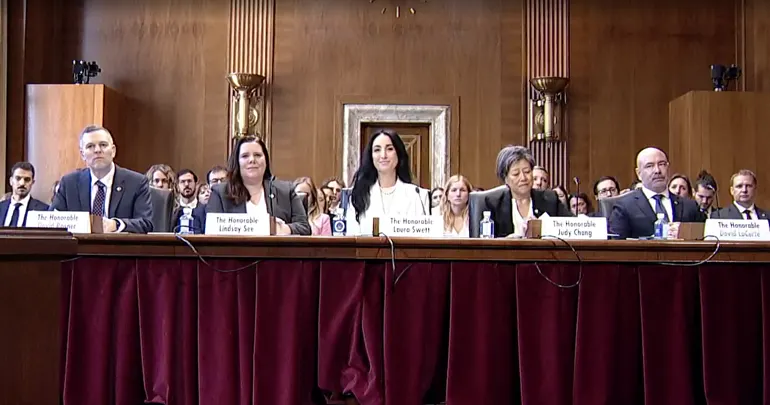
The Federal Energy Regulatory Commission (FERC) has announced a new task force focused on “grid-enhancing technologies” (GETs). This initiative aims to explore how the agency can provide support, potentially through incentives, as stated by FERC Chairman Laura Swett during an oversight hearing in the U.S. Senate.
Utilities have started incorporating GETs, which include tools like dynamic line ratings and advanced power flow controllers, with promising results on cost savings. However, while the Federal Power Act prohibits FERC from mandating these technologies, it allows the agency to encourage transmission owners to assess their economic impacts.
FERC may consider including GETs in its processes for granting incentives to transmission developers. During this process, the agency can ask for details about the technologies in use and alternatives considered. Sen. Angus King, an independent from Maine, emphasized that while FERC cannot enforce technology use, it is responsible for ensuring that rates are fair for consumers. He pointed out that utilities may currently have little motivation to invest in GETs, as they benefit from maximizing their infrastructure investments.
King suggested finding ways to incentivize utilities to explore cost-effective technology options, warning that the financial burden of enhancing the grid could significantly increase in the coming years if not managed wisely.
Additionally, the PJM Interconnection, the nation’s largest electricity market, faces challenges and discussions about governance improvements. Swett expressed optimism about identifying necessary changes in market management. Current efforts to enhance grid competition have also been limited since the introduction of FERC’s Order 1000, which sought to increase competitive practices.
Swett remarked that there is a need for further efficiencies through competition, especially concerning the backbone transmission system that supports increased electricity demand. Meanwhile, FERC has issued “show cause” orders to major grid operators, addressing the need for faster integration of data centers and other large loads into the grid.
These orders are designed to accelerate the modernization of transmission services and ensure accountability among generation providers. By pushing for advanced transmission technologies, FERC hopes to streamline the process of balancing load demands with new energy generation.
In summary, FERC is actively exploring ways to support and enhance the efficiency of the electricity grid while ensuring consumer interests are protected through careful examination and future innovation.