

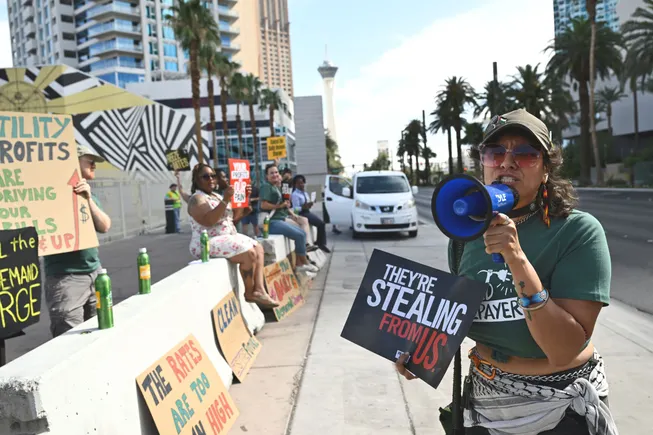
Last month, a conference in Las Vegas for executives of major utility companies was interrupted by protesters. Their anger stemmed from soaring electricity costs, highlighting growing public frustration with utility companies. This unrest is pushing the industry to defend its profit margins, which are legally guaranteed.
As concerns about affordability rise, several states are looking to lower the return on equity (ROE) for utilities through various regulatory and legislative strategies. While consumer advocates argue this is long overdue, utility companies warn that reducing ROE could hurt their credit ratings, potentially leading to higher costs for customers.
Experts suggest that the critical role of electricity in modern life, coupled with its increasing costs, could mark a shift in what society deems acceptable in terms of utility profit margins.
In Maryland, a significant rate case is pending. Utility executives argue that decisions should rest with state regulators, while advocates argue for a reduction in utility profits to align more closely with customer service costs.
### Utilities Under Pressure
The issue of affordability has become more urgent as electricity prices rise faster than inflation. A recent Pew Research survey revealed that 85% of respondents believe utilities are partly to blame for rising energy costs as they seek higher profits.
Data shows that investor-owned utilities, which account for about 70% of electricity sales in the U.S., charge higher prices than publicly owned utilities. Reports indicate that these companies are seeking record revenue requests, which have reached $18 billion last year, surpassing historical averages.
Amid these concerns, community resentment is also growing towards data centers that significantly increase resource demands, fueling questions about the profit structure of regulated utilities.
Utility profit margins are usually set by regulators and are currently averaging around 9.7%. These margins fluctuate between 9% and 10.5%. In contrast, unregulated sectors operate with varying returns but lack the obligation to seek regulatory approval for profits.
Dani Marx from the Edison Electric Institute emphasized that this responsibility falls on independent state regulators to assess infrastructure needs transparently.
In recent decisions, California regulators have reduced ROE for its top investor-owned utilities. Other states are considering legislation to align utility ROE more closely with Treasury rates and other reforms.
### Politically Charged ROEs
States like Maryland are pursuing legislation that reduces utility returns by mandating power companies to join regional groups, which would effectively eliminate profit “adders” from voluntary participation.
In Virginia, New Jersey, and Pennsylvania, leaders are urging regulators to scrutinize rate requests more closely, hinting at possible direct actions in the future.
Concern over utility profits is also making waves in Congress, where Rep. Greg Casar has proposed a bill requiring utilities to use the lowest reasonable ROE in calculations. This move aims to save money for electricity users.
Mark Ellis, a consultant, argued that decreasing utility profits can lead to overall savings for customers, labeling current profit levels as unjust enrichment for utility investors.
Utilities, however, believe that maintaining high profit margins is essential to attract necessary capital at low interest rates, which ultimately benefits ratepayers by supporting reliable service.
If a utility fails to maintain competitive returns, its ability to secure funding could be compromised, affecting service reliability.
### The Pepco Case
The ongoing Pepco rate case serves as an example of the debate surrounding utility profits. Pepco is seeking to increase its ROE from 9.5% to 10.5%, while consumer advocates suggest a much lower number of 7.7%. Critics argue that Pepco’s recent infrastructure investments may not be justified by immediate needs.
While Pepco argues that substantial investments are crucial for meeting Maryland’s climate goals, detractors say they’re pushing for unnecessary spending that could burden customers for years to come.
As discussions continue, utilities are under pressure to align profits with customer expectations and address the soaring costs of energy. The outcome of the Pepco case is anticipated to have significant implications for future utility profit frameworks, with a decision expected in August.
### Exploring Solutions
Acknowledging that reducing ROE can affect credit quality, some utilities have faced downgrades from credit agencies due to fluctuating regulatory conditions. Yet, there are suggested methods to mitigate financial impacts while still providing savings to ratepayers.
One proposed solution includes competitive direct equity, a model that would replace set ROEs with a market-driven approach to determine the cost of equity through competitive bidding. This could reshape the incentive structure for utilities and potentially lead to more equitable outcomes for consumers.
Utilities are accustomed to navigating complex regulatory systems and typically advocate for higher ROEs in their proposals. However, critics warn that overly generous profit margins could ultimately hinder affordability for customers, a sentiment echoed by experts from various fields.
Through this evolving landscape, regulators face the continual challenge of balancing utility needs with the financial realities faced by everyday consumers.