

Top executives in the nuclear fuel industry are urging Europe to end its imports of enriched uranium from Russia. They are concerned that the Kremlin is leveraging its significant supply role to gain geopolitical power.
Since the onset of Russia’s invasion of Ukraine nearly four years ago, Europe has worked to minimize its reliance on Russian enriched uranium. However, approximately 25% of the continent’s uranium still comes from Russia, primarily due to its competitive pricing.
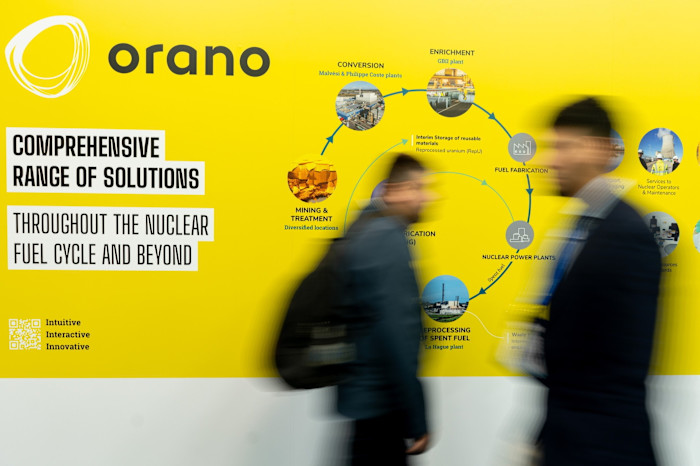
Urenco and Orano, major Western uranium producers, are investing in new enrichment capabilities driven by a rise in demand for low-carbon energy, which is sparking a nuclear revival in North America and Europe. However, much of the new supply has already been secured by U.S. companies in anticipation of a total ban on Russian uranium imports by 2028, as stated by Orano’s CEO, Nicolas Maes.
The leaders of both companies warn that without a strategy to stop these imports, Europe might continue its dependency on Russian fuel for many years, which would tie the continent to the politics of Vladimir Putin’s regime.
According to Urenco’s CEO, Boris Schucht, Russia is exploiting its enrichment business as a tool for geopolitical maneuvering. Maes pointed out that this situation is comparable to Europe’s reliance on China for essential materials used in technologies like wind turbines and electric vehicles. He emphasized that political decisions will shape how much dependence Europe is willing to bear.
Enriched uranium is created through a process that refines mined uranium, converting it into gas and increasing the concentration of specific isotopes necessary for nuclear energy production. Historically, Russia has been a dominant supplier, with its state-owned Rosatom accounting for about 44% of global enrichment capacity.
The Biden administration has already prohibited Russian uranium imports, with exceptions available until 2028. However, Maes notes that Europe lacks a similar framework, which complicates matters.
Schucht expressed the need for clear directives from political leaders about what is expected from the nuclear industry, mentioning that Urenco’s aging facilities require investment and a solid plan for the future.
The European Commission previously announced plans for a ban on Russian nuclear fuels as part of efforts to lessen the EU’s energy dependency on Russia. Although officials indicated that the documents were ready, the ban has been stalled due to internal disagreements, with concerns that it may worsen relations with Hungary and Slovakia, nations that still support Russian gas and oil.
Different countries are responding in varying ways, with Sweden cutting ties completely with Russian fuel, while others maintain imports. Hungary, for instance, is constructing new nuclear reactors designed by Rosatom.
In 2024, Europe is projected to import around 23% of its enriched uranium from Russia, equivalent to 2.5 million standard work units (SWU). Analyst Ben McWilliams noted the significant trade flow with Russia and emphasized the challenges in quickly finding alternative suppliers, given the time it takes to develop capacity.
Urenco and Orano are both ramping up their enrichment capabilities to meet growing demand. Orano is investing €1.7 billion in its Tricastin facility in France, aiming for a 30% capacity increase with partial funding from the European Investment Bank.
Operations at these facilities involve intricate processes where uranium hexafluoride gas is treated in centrifuges to separate various isotopes in the required proportions for fuel.
Urenco is also upgrading its facility in the Netherlands. Schucht believes that with the planned expansions, both Europe and the U.S. should be able to manage without Russian imports. Orano has additionally secured funding from the U.S. government to support a new €5 billion facility in Tennessee, expected to be operational by 2032.
However, these expansions will require time, and without a clear commitment to new nuclear projects, there might be insufficient capacity to meet future needs, warns analyst Teva Meyer.
While U.S. imports of Russian enriched uranium stand at about 3 million SWU, experts predict this will decrease with the Biden administration’s ban. Yet, industry stakeholders remain cautious about making significant investments without a stable client base, especially after past market fluctuations initiated by events such as the Fukushima disaster in 2011.
At Tricastin, Maes argued in favor of quotas on Russian imports to encourage long-term contracts with Western suppliers, which would help stabilize the market.
Nonetheless, removing Russia from the supply chain entirely presents challenges, primarily due to the increasing reliance on Kazakh uranium by Russia and China. Setting up new mines involves extensive timelines.
Analysts note that cost remains a significant factor in Russia’s ongoing role, while some believe that if peace is reached in Ukraine, Western utilities may return to purchasing Russian uranium. There is still uncertainty among nuclear power operators regarding contractual agreements, which complicates long-term planning with alternative suppliers.