

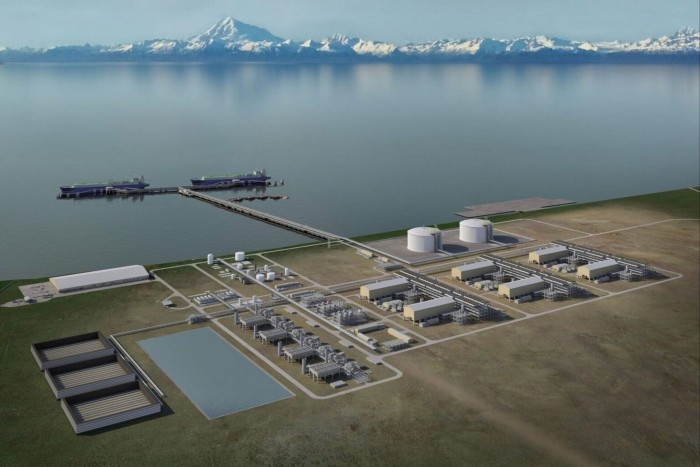
Donald Trump’s recent trade deal with Japan has attracted attention, particularly due to its inclusion of a joint venture for natural gas in Alaska. Alongside reduced tariffs and investments, this venture aims to bring to life a long-discussed liquefied natural gas (LNG) project, which would feature an extensive 800-mile pipeline. Analysts suggest that the total cost could exceed $60 billion.
The U.S. government argues that this pipeline would significantly improve gas supply to Pacific allies by linking Alaska’s northern gas fields to the southern port of Nikiski. Washington’s strategy has included persuading Japan and South Korea, two of the world’s largest LNG consumers, to support the project as part of broader tariff discussions.
However, the administration has faced challenges in convincing these Asian countries to participate, with many experts and industry insiders expressing skepticism about the project’s financial viability. Rapidan Energy Group, a consultancy based in Washington, has characterized the initiative as overly reliant on political motivations rather than sound commercial reasoning.
To date, no Asian firm has invested in the project, and discussions around securing nonbinding agreements to purchase LNG remain unsettled. Ryosuke Tsugaru, an executive at JERA—Japan’s largest natural gas buyer—acknowledged that while the concept is appealing, further details are crucial before committing to long-term contracts. He noted that Japan is approaching the Alaska LNG situation cautiously, wanting to provide a goodwill gesture to Trump.
In talks between U.S. and Japanese officials, the White House described their collaboration as an exploration of a potential agreement, which falls short of the “joint venture” claim made by Trump. A South Korean representative also voiced doubts about the project’s economic feasibility, particularly regarding pipeline construction costs.
While South Korea has committed to purchasing $100 billion worth of U.S. energy over the next four years as part of a trade deal, they clarified that no commitments have been made towards the Alaska LNG project. There is a sense that U.S. pressure has influenced the interest of Korean gas buyers in investing.
Historically, Alaska has shipped LNG to Asia since the late 1960s, but as its southern gas fields deplete, the focus has shifted to piping gas from the north. The current proposal has been stalled for over a decade and saw major energy companies pull out back in 2016.
As Trump strives to revitalize this project, he emphasized in his State of the Union address that several countries are interested in investing significantly. However, concrete commitments remain limited. While some interest has been shown by Taiwan and Thailand’s state-owned energy companies, much uncertainty still clouds the project’s future.
Many analysts remain doubtful that the Alaska LNG project will actually move forward. Estimates of the project’s costs continue to rise, with risks highlighted regarding legal challenges and potential overspending.
The political implications of the project have raised concerns, as the Trump administration appears to use it to bolster its “energy dominance” policy and leverage trade discussions. The likelihood of the project receiving final investment approval seems low, according to experts.
Brendan Duval, CEO of the primary developer Glenfarne Group, refrained from providing a new cost estimate, and indicated that concerns surrounding the Alaska project are based on flawed comparisons with other LNG endeavors. He warned against neglecting the interests of South Korean and Japanese buyers, stressing the importance of moving forward with the project.