

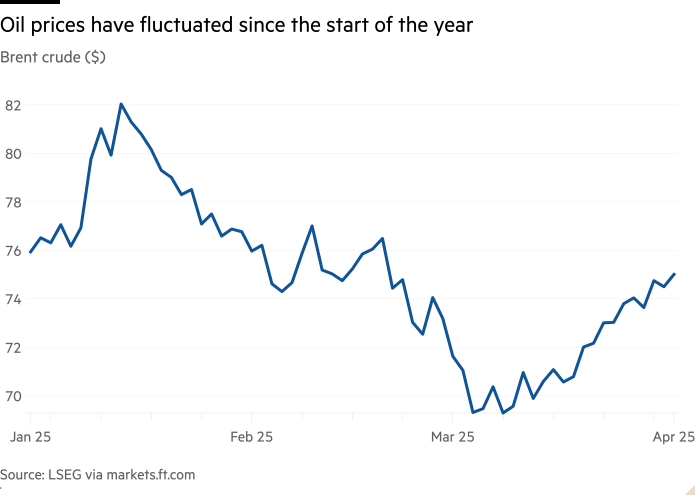
The world is trying to understand the impact of Donald Trump’s recent “liberation day” announcement on the economy. Last Wednesday, the US president stirred the markets by intensifying the trade conflict and introducing “reciprocal tariffs” on key trading partners. This move significantly affects the US energy sector, which heavily depends on imports for clean technologies and equipment.
In related news, Dominion Energy, one of the largest utility companies in the US, plans to increase consumer bills by 14%. This increase is attributed to rising labor costs, material expenses, and needed upgrades to the power grid amid increasing electricity demand. The proposed rate hikes come at a time when Trump’s trade measures may drive prices up further.
Today’s focus is on the deepwater oil sector and its resilience to oil price changes compared to shale production.
How Deepwater Producers Stay Strong During Price Variability
Weak oil prices have prompted concerns from shale industry leaders, but analysts suggest that deepwater oil producers are more resilient against price fluctuations. This year, oil prices have varied greatly due to uncertainties surrounding Trump’s trade policies and sanctions on Russian oil exports. Recently, Brent crude prices settled at $75.02 a barrel, while US West Texas Intermediate was at $71.80 a barrel.
Deepwater projects possess longer development cycles, making them less susceptible to the ups and downs of oil prices and political climates. “Even if the [Trump] administration could affect oil prices in the short to medium term, the most resilient developments against these fluctuations are significant finds in deepwater,” remarked Øivind Tangen, CEO of SBM Offshore, which develops and operates floating vessels for deepwater oil production.
Recently, deepwater drilling has regained traction, becoming a key growth area for large energy companies with new discoveries fuelling exploration efforts. S&P Global estimates that by 2030, deepwater production could reach 20 million barrels of oil equivalent per day, accounting for 20% of global oil output, while shale production is only expected to grow by 14 million barrels per day, representing 13% of global supply.
The potential of deepwater oil stands in stark contrast to the frustrations faced by shale producers, who are grappling with low prices and the unpredictability of Trump’s trade policies. Long-term projects in deepwater can take five to ten years to develop, while shale producers can adjust their operations much quicker based on current oil prices.
Tangen pointed out that SBM Offshore has numerous projects planned out to 2051, showcasing the long-term vision necessary for deepwater operations. In 2022, the sector attracted nearly $100 billion in investments, the highest since 2016.
On the other hand, shale executives shared concerns in a survey by the Federal Reserve Bank of Dallas that a continued decline in oil prices could severely impact their sector. While Trump’s trade advisor suggested that $50-per-barrel oil might help control inflation, shale producers warned that such prices would hurt profits and lead to curtailing production.
Rystad Energy indicated that the average break-even price for deepwater offshore projects is $43 per barrel, while North American shale projects require $45 per barrel. Both sectors could withstand some price drops, but deepwater projects often cannot halt drilling quickly in response to price declines.
Still, the many deepwater fields already located mean that production delays will rely more on project timelines than fluctuating oil prices.
Job Changes in the Industry
Bashir Ojulari has been appointed as the new CEO of the Nigerian National Petroleum Company, following the dismissal of the previous board.
Thames Water has chosen Steve Buck as its new chief financial officer, succeeding Alastair Cochran, who stepped down unexpectedly last month.
The Tennessee Valley Authority has promoted Don Moul to CEO, replacing the retiring Jeff Lyash.
Greg Columbus now serves as the non-executive chair of Pilot Energy, taking over from Brad Lingo, who remains managing director.
- Livium has appointed Phillip Campbell as the independent non-executive chair of the company.
Power Points
A senior UK Treasury minister is optimistic that private financing for the Sizewell C nuclear power station will be secured ahead of a crucial investment decision next June.
Commodity traders are leveraging profits from the energy crisis to invest in new assets, including expanding into metals trading and biofuels.
- Danish energy traders are developing algorithms to improve their position within the renewable energy market.