

Shale oil executives have raised concerns that Donald Trump’s trade policies could negatively impact their drilling operations. One producer expressed to a survey from the Federal Reserve Bank of Dallas that the current situation is damaging the commodity markets.
In the UK, Shell is trying to enhance its market value to rival ExxonMobil and Chevron. To do this, the company is reducing capital expenditures to enable more share buybacks, though many analysts believe it will struggle to catch up to its American competitors.
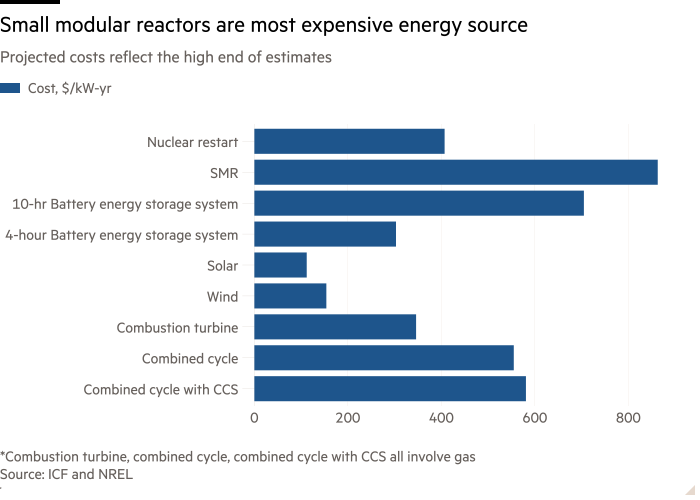
Today, we delve into a report from ICF that sheds light on the significant cost challenges the nuclear industry faces.
Nuclear Power’s High Costs and Long Timelines
As demands for electricity surge due to the rise of artificial intelligence, interest in nuclear energy is growing once again. However, obstacles remain in the form of high costs and extended timelines that could hinder its resurgence.
A recent report from consultancy ICF indicates that the anticipated nuclear revival is not guaranteed. The report raises concerns about the economic feasibility, technological development, and prolonged timelines associated with nuclear projects.
Re-establishing nuclear plants could carry costs ranging from $356 to $407 per kilowatt (kW) annually, while small modular reactors (SMRs) could see costs soar to $863 per kW annually. This is notably more expensive than power generated from gas-fired plants or those utilizing carbon capture.
“There’s a lot of uncertainty around both the technology and, importantly, the cost,” said Shanthi Muthiah, ICF’s managing director for energy advisory. “This brings significant financial risk.”
The U.S. is experiencing a surge in energy demand driven by the race to lead in artificial intelligence, with burgeoning energy-hungry data centers. This spike in requirements for low-carbon, stable power sources is pushing companies to focus on new nuclear technologies and even consider the revival of decommissioned reactors, such as Microsoft’s initiative to partner with Constellation Energy to bring back the Three Mile Island facility, infamous for its historical accident.
Moreover, earlier this month, influential companies like Amazon, Google, and Meta called on governments and utilities to triple nuclear energy capacity by the middle of the century. Notably, Amazon acquired a stake in SMR developer X-energy last year, while Google struck a power supply deal with Kairos Power. Meanwhile, Meta is assessing proposals from SMR developers proposing up to 4GW of new capacity starting in the early 2030s.
Though reopening existing nuclear plants seems a more viable option to temporarily meet demand, experts caution that they alone won’t provide enough new supply for data centers, as only a few facilities currently have the capability to reopen.
The future of nuclear energy heavily depends on emerging technologies like SMRs, which are yet to be operational in the U.S. and whose costs remain an enigma for investors. In 2023, NuScale decided to cancel what would have been the first SMR project in the U.S. due to a lack of interested buyers, and another SMR developer, Oklo, has postponed its first reactor deployment from late 2027 to early 2028.
Despite potentially high revenues for new nuclear plants allowing for operator profitability, their success is largely contingent on federal tax credits that are set to phase out by 2034, a timeline that may be too tight for the traditionally slow-moving industry.
There is also a scaling issue — SMRs necessitate more enriched uranium than conventional plants. Presently, the U.S. faces challenges in sourcing enriched uranium, particularly after supply restrictions from Russia, a primary supplier, and years of underinvestment in fuel.
NuScale has not yet secured a partnership with any large data center company in the U.S. Chief Executive John Hopkins mentioned the “complexity of putting these deals together” as a reason for the delay.
Lawrence Coben, CEO of NRG, noted that big tech companies aren’t relying on nuclear energy. Meanwhile, Matthew Crozat, executive director of the Nuclear Energy Institute, highlighted that one significant challenge for the industry is the pace of construction to meet the rising electricity demands.
“We have new technologies… it takes a while to build them,” Crozat pointed out, referencing that some data centers are aiming to come online in just 18 months.
To that end, Muthiah noted that the demanding financial requirements for nuclear power projects are limiting the number of buyers that can feasibly manage them on their balance sheets. Simplifying reactor designs could lead to cost benefits by shortening construction times, according to experts.
Koroush Shirvan, a nuclear engineering professor at MIT, observed that China has managed to reduce the construction timelines for its reactors by 50% due to standardized designs. However, he cautioned that sufficient incentives are crucial to advance the U.S. nuclear industry.
“We need enough incentives to build more reactors and leverage the economic advantage of standardization,” he said.
Job Moves
- Kunlun Energy has appointed Jin Guanghui as the new chief financial officer, succeeding Gao Xiangzhong.
- Mangalore Refinery and Petrochemicals has named Devendra Kumar as chief financial officer and finance director.
- Randall James Connally is now the executive director and chief executive of ADM Energy, having previous experience as the chief financial officer of Atlantic Bridge.
- Luke Velterop has been appointed as the chief executive of Top End Energy; he was previously the vice president of U.S. operations following the acquisition of Serpentine Energy, a natural hydrogen explorer.
Power Points
- Gazprom, Russia’s oil and gas company, continues to face significant recovery challenges following record losses connected to the Ukraine war.
- Rolls-Royce has cautioned the UK government that it risks falling behind in the competition to build small nuclear reactors unless it selects its builders by the end of June.
- Environmentalists have disputed the UK government’s recent decision to approve new oil and gas licenses in the North Sea.