

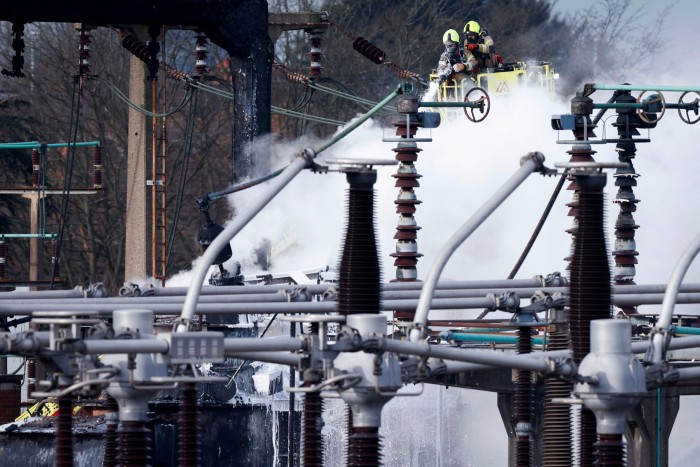
Heathrow Airport is facing increasing criticism following its decision to close for nearly 24 hours due to a fire at a nearby electrical substation, despite being connected to other power sources. This closure happened last Friday while airport officials worked to restore complete power to the facility, which requires as much electricity as a small city.
According to John Pettigrew, the CEO of National Grid, which oversees Britain’s high-voltage power network, two other substations that supply electricity to Heathrow were still operational during the incident. This meant that power remained accessible, although the airport could not access it promptly.
Concerns about the reliability of the UK’s critical infrastructure have prompted Prime Minister Sir Keir Starmer to emphasize that there are questions the airport’s management needs to address regarding the extent of the disruption caused.
Why Wasn’t There Enough Backup Power?
Heathrow has sufficient diesel generators to manage essential operations, including its control tower and runway lights, and passengers were safely evacuated after the initial power outage. However, these generators do not have the capacity to power the entire airport.
Simon Gallagher, managing director of UK Networks Services, noted that while Heathrow has better backup supplies compared to many airports, the aviation industry overall struggles with resilience. He pointed out that other sectors that depend on substantial power connections ensure they have continuous supply.
In response to the power outage and the airport’s closure, Heathrow has initiated an internal review led by Ruth Kelly, a board member and former transport secretary. Meanwhile, the National Energy System Operator is conducting a separate investigation to assess the outage’s effects on the airport and its surroundings.
How Does Heathrow’s Resilience Compare?
A nearby data center, Ark Data Centres, which has 12 emergency generators, was also impacted by the same fire but managed to avoid disruption by activating its backup power. CEO Huw Owen expressed that clients expect resilience in power supply.
Energy Minister Michael Shanks has also criticized Heathrow, suggesting that there is “significant redundancy” in the energy infrastructure surrounding the airport. He mentioned that local network operators and National Grid were able to quickly re-establish connections for households in the area. He explained that while the external network needs reviewing, the airport’s internal power network must be reassessed.
A recent U.S. government report indicated that one major airport maintains numerous diesel generators equipped to power its operations for an extensive duration. Analysts suggest this airport stands out in terms of preparedness.
Olivier Jankovec, director-general of Airports Council International Europe, emphasized that resilience involves balancing risk and costs. He acknowledged that minimizing disruptions is not always feasible, particularly during rare extreme events.
Why Did It Take So Long to Restart Systems?
The fire at North Hyde substation caused a temporary shutdown, but two other substations could still provide power to the airport. However, Heathrow stated that accessing this power required reconfiguration of its internal electrical systems.
This necessary process involved sending technicians to the airport’s power distribution points. They needed to manually operate circuit breakers to disconnect from the compromised substation and reconnect to the others.
Heathrow also had to methodically restart and test hundreds of systems before operations could resume. The airport explained that due to its size and complexity, safely restarting after such a significant disruption posed a considerable challenge.
It is not clear how long each step took, leading some experts to express surprise at the duration required to restore normal operations. Heathrow announced its closure at 4:30 a.m. on Friday, but systems began to reboot by 12:30 p.m., and the first flights took off around 7:00 p.m. Transport Secretary Heidi Alexander noted that by 4:00 p.m., the airport was confident that systems were functioning correctly.
Some experts believe that this incident reveals a failure in process management and that Heathrow may have underestimated the potential for such a major failure.
Should Heathrow Have Been Better Prepared?
According to Malte Jansen, an energy policy researcher, contingency planning typically involves weighing economic factors. He noted that no system can be entirely fail-proof. However, power industry leaders assert that Heathrow’s status as Europe’s busiest airport demands higher preparedness levels, particularly the ability to quickly switch power sources.
A 2014 report by Jacobs consultancy stated that even brief interruptions to power can have lasting impacts, highlighting that Heathrow possesses on-site generation and seems well-equipped in terms of resilient energy supplies. However, concerns have been raised about the efficiency of the infrastructure in light of rising landing fees and aging facilities.
Heathrow has invested approximately £7.4 billion in capital projects since 2014, including upgrades, but airlines have criticized how this money has been spent.