

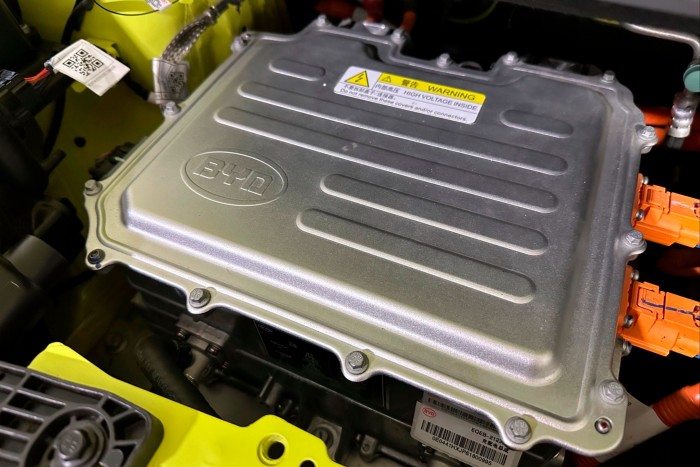
BYD, the Chinese electric vehicle company supported by Warren Buffett, is making waves in the global auto market once again. Recently, the company’s founder, Wang Chuanfu, introduced a new charging system designed to enhance the driving range of BYD’s electric vehicles significantly.
This system, known as the Super e-Platform, allows BYD’s batteries to gain approximately 470 kilometers of range within just five minutes of charging. This advance positions BYD as a leader in the push to create faster-charging technology for electric vehicles, comparable to the quick refueling of traditional petrol or diesel cars. This follows an earlier announcement about the company’s “God’s Eye” driver assistance system, which is now being offered free across all models.
New Speedy Charging Technology
BYD claims that their new charging platform provides a power of up to 1,000 kilowatts and can handle 1,000 amps. This means that it can charge batteries at an impressive rate, adding around 400 kilometers of range in just five minutes.
This development suggests that BYD has overcome various challenges associated with superfast charging, such as safety concerns, battery longevity, and the costs related to installing these quick chargers. Such improvements might help to address common worries consumers have about electric vehicles, particularly their longer charging times compared to traditional cars.
Experts believe that BYD’s innovative battery cooling system gives it an edge over many Western automakers, allowing for efficient and sustained charging. Shay Natarajan from Mobility Impact Partners has commented on how the new technology enables batteries to reach peak charging power quickly and maintain that efficiency throughout the charging process.
Competition in the Market
Tesla, a dominant player in the electric vehicle space, has a significant network of superchargers worldwide. However, its current capabilities fall short of what BYD is now claiming. For instance, Tesla’s chargers can provide an added range of about 320 kilometers in 15 minutes, which is considerably less than BYD’s promise.
Other manufacturers, like Mercedes-Benz and BMW, are also working on their charging technologies. Mercedes recently launched a model that can recharge up to 325 kilometers in just 10 minutes, while BMW has introduced a battery offering 30% faster charging, amounting to 300 kilometers in a similar timeframe. However, both still lag behind BYD’s new technology.
Chinese battery manufacturer CATL is also stepping up its game with its Shenxing Plus battery, which boasts an impressive charging speed of about 600 kilometers in just 10 minutes.
Expansion Plans
BYD’s new charging technology will first be made available in its Han L sedan and Tang L SUV models, part of their flagship lineup. The company plans to set up around 4,000 chargers initially to support this fast-charging capability. Analysts from Goldman Sachs have described BYD’s Super e-Platform as highly competitive due to its swift charging speed, which could accelerate the development of the electric vehicle market.
However, they have raised concerns about the pricing of the new models, pointing out that they may be more expensive than comparable options from competitors.
The Bigger Picture
The introduction of behind-the-scenes technology like the Super e-Platform and God’s Eye is increasing pressure on automakers globally. BYD’s comprehensive control over its electric vehicle technology is seen as a unique advantage, allowing it to integrate these advanced features into its range of models more effectively compared to other manufacturers.
Despite these advancements, BYD still faces challenges in international markets due to rising trade barriers and concerns about the safety of Chinese technology. Nonetheless, as regulations tighten globally, companies like BYD could find a significant foothold, particularly in regions focusing on sustainability and environmental practices.
As the electric vehicle race heats up, BYD’s latest innovations may give it a leading edge, prompting other manufacturers to accelerate their own technological advancements to keep up.