

Welcome to this edition of Energy Source from London.
Recently, U.S. President Donald Trump announced a 30-day delay on tariffs aimed at Mexico and Canada, following these countries’ efforts to improve border security. Meanwhile, China has altered the dynamics of the coal, gas, and oil markets by introducing its own tariffs on these resources.
What does this mean for the industry? U.S. refineries are facing a challenging month ahead as they adjust to a shaky supply chain, while traders might benefit from the resulting uncertainty. Interestingly, China, which relies heavily on imported oil and gas, has some new strategies. Although it imports limited U.S. crude, China is increasingly reducing its gasoline and diesel needs as it expands its electric vehicle fleet. Additionally, stronger ties with Russia amid the ongoing Ukraine conflict allow China to secure affordable gas and oil supplies.
While China is still a major purchaser of U.S. coal, it has various alternatives, including supplies from Australia and Indonesia, as well as local production. Should the U.S. impose tariffs on Canadian oil, China and other Asian countries are likely to step in as significant buyers. On the natural gas front, Chinese tariffs on U.S. LNG might see increased American shipments to Europe.
Which companies should investors watch closely? Besides U.S. and Canadian producers and pipeline and refinery companies, BP could feel the impact of higher prices, with 40% of its refining capacity located in the U.S. This potential tariff situation adds to the challenges the UK oil giant is currently facing with its investors.
In this edition, we also look into a recent report on future investment trends in the energy transition.
Latest Trends in Energy Investment
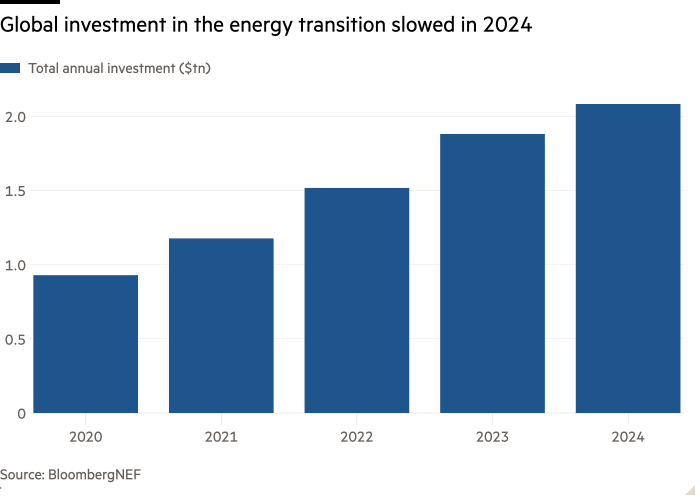
BloombergNEF, a prominent renewable energy research entity, has published its annual report on investments in energy transition. In 2024, global investments reached about $2.1 trillion, an 11% increase compared to the previous year, although this is a slower growth rate than in prior years, with China being the predominant player.
Some key insights from the report include:
The solar, battery, and electrolyzer manufacturing sectors are currently facing overcapacity. This could keep prices low, prompting Gulf nations, for instance, to heavily invest in solar farms supported by substantial storage battery systems. Nevertheless, the study suggests potential cuts in future investment as many manufacturers might reconsider or halt their expansion plans.
China remains the center of manufacturing, with 81% of supply chain investment occurring there in 2024. Countries like the U.S., Europe, and India aspire to produce their solar panels and batteries but struggle to compete on pricing.
There is an increasing divide between established sectors with viable business models and those relying on cheap funding or political favor. Last year, 90% of investments flowed into electric vehicles, renewable energy, and power grids, particularly noting energy storage’s significant growth to $54 billion—outpacing nuclear investments.
- Conversely, investments in riskier sectors, such as carbon capture and hydrogen technology, have drastically decreased, emphasizing that emerging technologies often require government incentives to thrive, which may not align with current political climates in regions like the U.S. and Europe.
Thank you for joining us in this discussion on energy transition investments!