

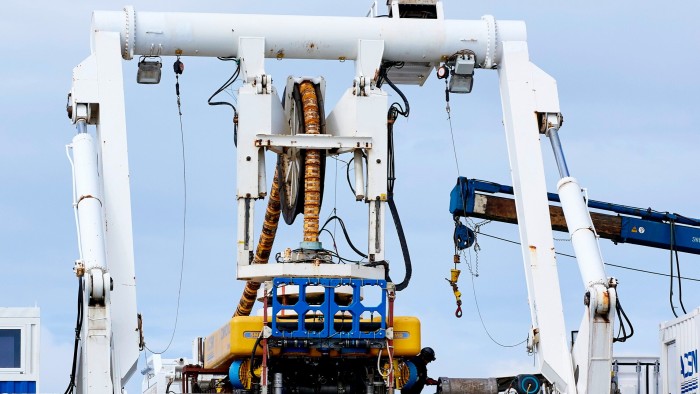
Subsea cables play a crucial role in global communications and energy transfer. If you laid them end to end, they would circle the earth 37 times! However, with the growing demand for renewable energy, the need for these cables is increasing. This shift has filled the order books of cable manufacturers, boosting their stock prices.
Despite their importance, subsea cables face numerous challenges. They are susceptible to various risks, including damage from sabotage and changes in the seabed. Additionally, the political landscape significantly impacts investor sentiment; for instance, Donald Trump’s presidency has raised concerns about future support for renewable energy.
Since the last election, shares of major companies like Nexans from France and NKT from Denmark have fallen. Italy’s Prysmian, the largest cable manufacturer, has experienced a significant decline, primarily due to a broader sell-off in the energy sector caused by a Chinese company’s advancements in AI technology that reduces energy consumption.
In Europe, the push for renewable energy, particularly wind power, is strong. Subsea cables are essential for transmitting wind energy from offshore locations to land and for sharing surplus energy among countries, as seen in the Nemo link connecting Belgium and the UK. The European Commission has a goal for member states to have interconnectors in place to enable 15% of their electricity capacity to be transported by 2030.
Looking ahead, the company Xlinks plans to transmit solar energy from Morocco to the UK through a massive subsea cable stretching 4,000 km. This ambitious project aims to provide 8% of the UK’s electricity needs by 2030, necessitating a £20 billion investment.
However, the path to achieving Europe’s green energy goals raises concerns. The energy sector, comprised of both public and private players with conflicting objectives, complicates the situation. For instance, a recent auction for offshore wind projects in the UK yielded no bids, as developers found the financials unfeasible.
Political issues also add to the uncertainty. Russia’s invasion of Ukraine highlighted Europe’s dependence on Russian gas, prompting a push for diverse energy sources, including renewables. However, much of the expertise and funding for subsea cables currently comes from China, which poses its own challenges.
Despite these hurdles, cable manufacturers are in a strong position. They hold a central role in the energy transition and have numerous projects in progress. While investors might hesitate, the subsea cable industry is one to watch closely as it becomes increasingly vital to our energy future.