

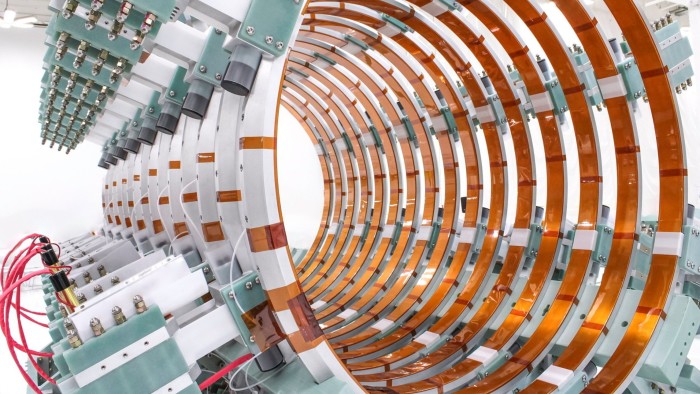
A new US start-up, backed by notable figures like Sam Altman and Peter Thiel, has successfully raised $425 million. This funding aims to help the company, Helion, meet its ambitious goal of producing electricity from nuclear fusion by 2028.
Among several competitors in the race for effective nuclear fusion, Helion has set the most aggressive timeline. Nuclear fusion, a long-awaited breakthrough technology, merges hydrogen atoms to create helium and release substantial energy.
Helion’s latest funding round attracted investment from venture capital firms Lightspeed and SoftBank’s second Vision Fund, alongside contributions from Altman, Thiel’s Mithril Capital, and the steel company Nucor. Overall, Helion has raised more than $1 billion and is now valued at approximately $5.4 billion.
Nuclear fusion presents a carbon-free energy source without the long-lasting radioactive waste that nuclear fission generates. While scientists have achieved short bursts of fusion reactions, recent advancements are promising. For example, Chinese researchers recently reported sustaining a fusion reaction for 1,066 seconds in Hefei, as claimed by state media.
In an exciting development, Helion has secured a contract to supply Microsoft with electricity generated from nuclear fusion by 2028 and plans to construct a 500 MW power plant for Nucor. According to Helion’s CEO David Kirtley, the new funds will enable the company to ramp up production of pulse capacitors, a vital component for its Polaris reactor in the U.S.
Kirtley emphasized that these capacitors have historically come from overseas and represent about one-third of the project’s total cost. By manufacturing them domestically, Helion aims to significantly cut down on wait times and production costs.
He noted that Polaris, Helion’s seventh-generation reactor, is “in operation” but withheld specific performance details. Kirtley expressed confidence in their technology, stating it is “smaller, cheaper, easier to build, and requires less concrete” compared to alternatives in the field.
Despite the challenges posed by regulatory needs and the quest for increased efficiency, Kirtley remains optimistic. He highlighted the ongoing demand for reliable power and stated, “There is a huge need for baseload power, even more than we thought before.”