

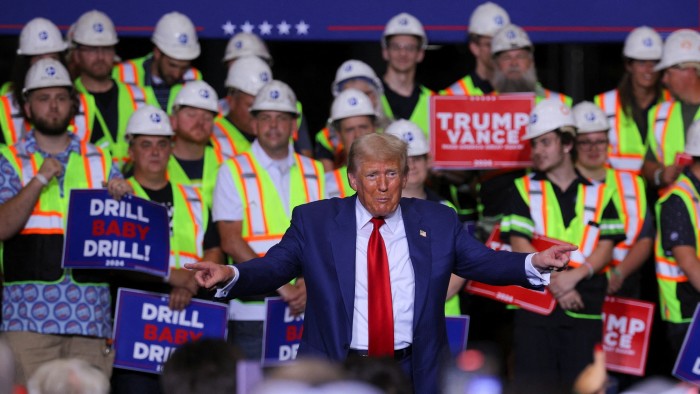
President Donald Trump’s hopes for a new oil boom might hit a wall due to Wall Street’s hesitance to back another round of drilling, according to shale industry leaders. Experts from Rystad Energy and Wood Mackenzie predict that oil production in the U.S. during Trump’s second term may increase by no more than 1.3 million barrels per day. This figure falls short of the 1.9 million barrels per day surge seen under President Joe Biden and is significantly lower than the dramatic increases of the past decade.
Shale executives express that external pressures from investors and the realities of fluctuating oil prices could hinder Trump’s ambitions for “American energy dominance.” Wil VanLoh, CEO of Quantum Energy Partners, highlighted that financial motives rather than political agendas will guide Wall Street’s decisions. “Drilling at all costs? I don’t see companies pushing for that,” he remarked.
The current situation may prove disappointing for Trump, who believes an increase in oil supply could help combat inflation by lowering the prices of goods and fuel. In his recent inauguration speech, he stated, “We will bring prices down… that liquid gold under our feet will help us become a rich nation again.” Furthermore, at the World Economic Forum in Davos, he urged OPEC to reduce oil prices, suggesting this could allow global central banks to lower interest rates promptly.
However, lower oil prices would likely reduce shale companies’ profits, making them less inclined to follow his directive to ramp up drilling. Ben Dell, managing partner at Kimmeridge, emphasized that “price signals will outweigh political motives.”
After reaching a record high in U.S. oil production last year, the Energy Information Administration forecasts a modest growth of just 2.6 percent to 13.6 million barrels per day in 2025, with only a slight increase projected for 2026 due to ongoing price pressures. Many in the shale industry worry that prime drilling locations may have already been exhausted after years of aggressive exploration in states like Texas and North Dakota.
In recent executive actions, Trump aimed to “unleash” oil and gas production and declared a “national energy emergency,” also striving to revoke regulations established during the Biden administration that producers argue increased their expenses.
Despite the administration’s supportive stance on fossil fuel development, executives warn that this might not significantly alter operational activity levels. David Schorlemer, CFO of ProPetro, voiced skepticism about any substantial increases in production.
After years of rapid growth in the oil sector, producers are now taking a more cautious approach, influenced by past price crashes that led to bankruptcies and a change in investor confidence. A survey by the Kansas City Federal Reserve revealed that an average oil price of $84 per barrel is necessary to see larger increases in drilling activity, while current prices hover around $74.
JPMorgan projects that U.S. oil prices may decline to $64 per barrel by year’s end, causing shale production to slow dramatically by 2026. S&P Global’s Hassan Eltorie noted that no amount of deregulation would significantly boost production if oil prices remain low.
In contrast, Chevron, one of the nation’s largest oil producers and a major investor in shale, plans to reduce its spending for the first time since the pandemic’s oil crash, allocating $14.5 billion to $15.5 billion for 2025. Meanwhile, other companies like ConocoPhillips and Occidental Petroleum are also adjusting their spending to align with investor expectations, illustrating the complexities facing the industry amid fluctuating market conditions.