

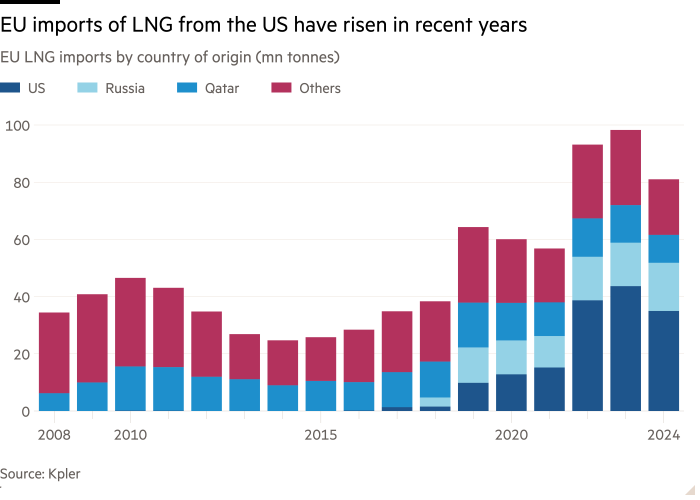
Donald Trump has issued a warning to the European Union (EU) about a potential trade war unless it increases its purchases of US oil and gas. Although Brussels has shown some willingness to cooperate, its ability to act on this matter remains limited, especially as European nations have been importing substantial amounts of less expensive liquefied natural gas (LNG) from Russia.
As the inauguration of the new president approaches, the challenge of whether Europe can collectively boost its purchase of American energy has become a significant topic in transatlantic relations. Trump expressed his demands for increased oil and gas purchases on social media, threatening tariffs if the EU does not comply.
Following Trump’s re-election, Ursula von der Leyen, the President of the European Commission, appeared supportive of the idea, suggesting the replacement of Russian gas with American LNG. However, since the EU’s executive body does not engage in gas purchasing, it can only convey to the incoming US administration that European companies have an interest in sourcing LNG from the US.
The bloc had previously committed to purchasing more LNG from America in 2022, but there are no immediate plans for further commitments. EU officials have indicated that they are not ready to revisit this agreement right away.
The core issue stems from Europe’s dependency on cheaper gas from Russia. Last year, European companies imported record volumes of LNG from Russia, raising concerns among US officials that this should be coming from the US instead.
In response to fears of potential gas shortages after Russia curtailed pipeline supplies, the EU has refrained from completely banning Russian LNG, as it did with coal. Instead, the bloc has set a non-binding goal to eliminate its dependence on all Russian fossil fuels by 2027.
While EU diplomats suggest that LNG could be included in future sanctions, implementing such measures would require unanimous agreement from all 27 member states, which could be difficult.
The Biden administration has recently added smaller Russian LNG facilities to its sanctions list, yet it has hesitated to act against major suppliers like Yamal, which plays a crucial role in Europe’s import supply. Analysts propose that if Trump seeks to bolster exports of American LNG to Europe, stepping up sanctions on Yamal would be a logical action.
The US energy sector is confident that it can provide sufficient volumes of LNG to replace Russian supplies in the European market. Reports indicate that significant quantities of LNG are already contracted from US facilities, exceeding the volume of Russian LNG imported by the EU last year.
Trump has committed to lifting restrictions on new LNG export capacity, which would enable the US to ship more gas to Europe. The EU also has the capability to increase its imports through regasification terminals, which convert liquefied fuel back into gas.
Despite the potential for increased LNG imports from the US, price remains a significant concern. The EU must balance its commitments to Trump with the need to manage energy prices, especially in Germany, where energy costs have soared.
The EU’s gas prices are significantly higher than those in the US, staying at double or even tripling their pre-Ukraine invasion levels. Price sensitivity is viewed as a critical factor influencing how Europe will engage with the US on LNG imports, as decisions on imports are driven by market dynamics rather than governmental directives.
Brussels could explore options like establishing a strategic LNG reserve that includes US shipments to enhance cooperation. Additionally, the demand for natural gas in the EU is expected to decline in the coming years, allowing more space for alternative supplies, particularly from nations like Qatar and Canada.
Experts believe that Europe is on the verge of diversifying its energy sources away from Russian LNG, which becomes increasingly manageable as new supply streams come online in the coming years.