

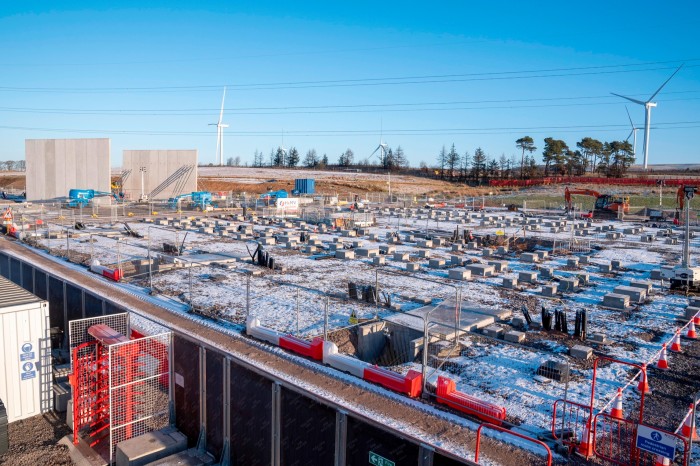
Scotland is set to become home to the three largest battery energy storage systems in Europe, thanks to a significant investment of £800 million from Copenhagen Infrastructure Partners. This investment will fund the construction of two new battery projects, Coalburn 2 and Devilla, which will provide a combined power capacity of 1.5 gigawatts.
The construction of Coalburn 2, located in South Lanarkshire, and the Devilla project in Fife is expected to begin shortly. Both facilities are scheduled to begin operations by 2027-2028 and will complement the Coalburn 1 project, which is already under construction and slated to start in October this year. Each of these new projects will have a capacity of 500 megawatts, making them the largest of their kind in Europe.
Together, the three projects will be capable of storing and supplying the electricity grid with three gigawatt hours of energy, enough to power 4.5 million homes for two hours. Scotland’s First Minister John Swinney praised this investment as a major step forward in enhancing the country’s energy infrastructure, commenting that it will contribute to a reliable power supply for homes and businesses, and push Scotland closer to achieving net-zero emissions.
As Scotland prepares for the May 2026 Holyrood elections, Swinney’s administration is focused on attracting investment. He emphasized that “Scotland is open for business.”
Historically, Europe has heavily invested in wind and solar energy, but only recently has it begun to recognize battery storage as a viable solution to the challenges posed by renewable energy’s variability. Last year’s total capacity for large-scale battery storage in Europe was just 10.8 gigawatts, with the UK leading investment in this sector at 4.5 gigawatts.
However, as the costs of battery technology decline, the appeal of such systems is growing. Construction of new facilities is anticipated in the coming years due to successful auctions across Europe. Scotland has become an attractive location for battery storage due to its abundant wind energy and outdated grid infrastructure. By 2030, it’s projected that approximately 60 percent of UK’s energy will come from wind, with Scotland providing around 31 percent of that energy.
The UK aims to significantly decarbonize its grid by 2030, targeting a battery storage capacity of 27-30 gigawatts—up from the current operational level of 4.5 gigawatts.
Battery energy storage systems are essential because they allow for charging when electricity prices are low and discharging during peak demand times, providing much-needed flexibility and support for renewable energy integration. Copenhagen Infrastructure Partners, a leading fund manager specializing in renewable energy investments, is currently involved in over 30 gigawatts of renewable energy infrastructure projects across the UK.
Yet, these energy storage sites have faced criticism from some local communities due to concerns about safety and noise pollution, highlighting a tension between industrial development and rural preservation. The Coalburn projects are set to be constructed near existing wind facilities on a site previously used for coal mining—representing a significant shift towards new forms of energy. Acting Secretary for Net Zero and Energy Gillian Martin highlighted the importance of ensuring these projects are appropriately located and that local communities receive tangible benefits from them.