

When considering an electric car, many buyers have two main worries: how far they can drive and how safe the batteries are. Solid-state batteries, which use safer materials, promise to address these concerns by reducing fire risks and providing longer driving ranges. However, despite significant efforts and investment over the years, this advanced battery technology still has not been fully developed.
Battery manufacturers who have invested heavily in solid-state technology are feeling the pressure, especially as profits shrink and electric vehicle (EV) sales growth slows in developed countries. An immediate solution that improves safety could help these companies buy time and create a profitable opportunity.
While critics often highlight the dangers of EV battery fires, the statistics tell a different story. Data shows that electric vehicles are significantly less prone to fires compared to traditional petrol or hybrid cars—reporting only 25 fires per 100,000 EVs sold versus 1,530 for petrol vehicles, as noted by the US National Transportation Safety Board.
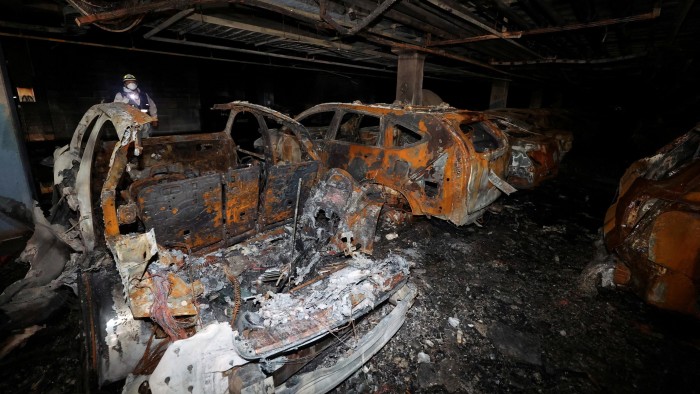
However, when lithium-ion batteries do catch fire, the situation can be more severe, burning at intense temperatures and releasing harmful gases, which contributes to public fear. A recent incident involving a parked Mercedes EV in South Korea—equipped with batteries from Chinese manufacturer Farasis Energy—created alarm when it took firefighters eight hours to extinguish the flames, damaging around 880 other cars in the garage.
Solid-state batteries are often hailed as a safer option, particularly during accidents, since they use non-flammable solid materials instead of the liquid electrolytes found in current battery technology. Some manufacturers have already started experimenting with prototypes and small-scale production.
Yet, scaling up production of these batteries may pose difficulties. The materials are costly, and setting up new manufacturing plants requires substantial investment, which is challenging for an industry already facing tight profit margins. Additionally, established lithium-ion batteries—built on decades of evolution and cost-cutting measures—remain a formidable competitor.
To enhance safety, it is important to identify when EV fires are most likely to happen. Research shows there were 511 EV fires reported globally from 2010 to June of last year among 40 million electric vehicles, including hybrids. Collisions and road debris were found to be the main causes, highlighting the need for better structural designs in electric cars to withstand impacts.
Companies like CATL, the largest EV battery manufacturer, are taking steps to improve safety. They are redesigning the foundation of electric vehicles—the skateboard chassis—by implementing new protective features for batteries. This includes disconnecting circuits within a fraction of a second after a collision and using high-strength materials for enhanced durability. In tests at speeds of 120 km/h, CATL’s latest design showed promise by avoiding fires during frontal crashes.
Battery makers that can bundle these safety features into their offerings will also benefit. The skateboard design integrates crucial elements like batteries and electric motors, simplifying manufacturing and reducing costs while appealing to both established automakers and new startups eager to enter the electric vehicle market.
The potential for solid-state batteries to significantly change the EV landscape is evident, but the slow pace of development is pushing manufacturers to explore other revenue possibilities. As the electric vehicle market faces growth challenges, innovations related to safety are likely to become essential for boosting consumer confidence and advancing adoption rates.