

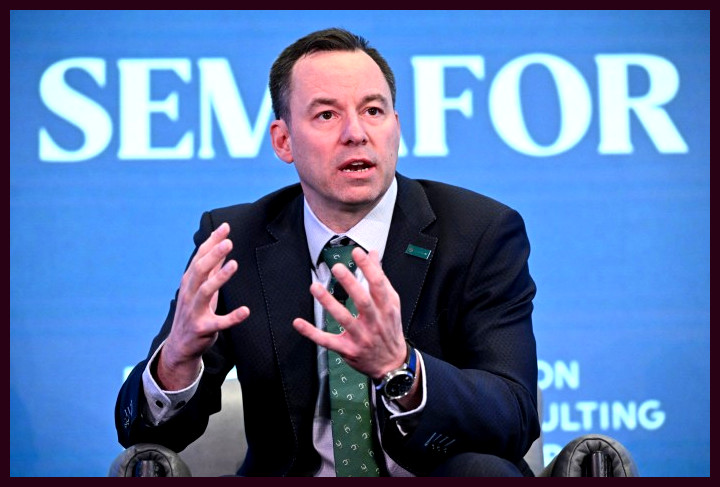
GE Vernova, the third-largest wind turbine manufacturer in the world (excluding China), is pausing its search for new offshore turbine contracts. CEO Scott Strazik is holding off on new deals as he waits for better market conditions.
Strazik mentioned that the offshore wind sector has been facing tough times due to supply chain issues and rising interest rates. Recent political developments, particularly Donald Trump’s potential re-election, add more uncertainty. Trump has promised to hinder offshore wind initiatives in the U.S. from the first day of his presidency, including cutting tax incentives for renewable energy.
However, Strazik clarified that GE Vernova’s current focus on completing existing offshore projects, such as its work on the Dogger Bank Wind Farm in the North Sea, is not influenced by the recent political shifts but is instead based on company strategy. He hopes for a future with better economic conditions that will allow for more profitable operations.
Currently, GE Vernova has a backlog of $3 billion in orders for offshore wind turbines, with no new additions to this backlog in almost three years. Strazik emphasized that the focus now is on successfully delivering on these existing commitments rather than expanding the backlog during the current uncertain pricing environment. He highlighted that offshore projects can be “exponentially more complicated” compared to onshore projects, reflecting the difficulties inherent in working at sea.
The offshore wind market plays a crucial role in many countries’ efforts to reduce carbon emissions, particularly in the U.S. and Europe. Nevertheless, the industry has faced multiple challenges, including high interest rates and difficulties in maintaining supply chains, which have squeezed profits at turbine manufacturers.
As wind farm developers aim for larger turbines to generate more energy from each unit, this pursuit has led to increased costs across the supply chain, impacting manufacturers’ profits. For instance, Siemens Energy recently received government support in Germany due to challenges faced in scaling up production.
GE Vernova, like others in the industry, is seeking to standardize its turbine offerings to enhance quality and reduce costs. However, the company recently announced plans that may involve cutting about 900 jobs in its offshore wind unit.
Looking forward, Strazik anticipates changes in the industry over the next couple of years, including the possibility of rising electricity prices or greater standardization that could alleviate cost pressures for manufacturers.
He also noted the bipartisan recognition in U.S. politics around the significance of clean energy investments for job creation, national security, and competitiveness on a global scale. Spun out of General Electric in April, GE Vernova employs more than 80,000 people worldwide in gas and wind turbine manufacturing and related equipment.
For the third quarter, the company reported losses of $317 million within its wind turbine segment, driven by increased offshore wind costs that outweighed gains from higher onshore wind margins. Nonetheless, it anticipates a “modestly profitable” outcome for its wind unit in the upcoming fourth quarter.