

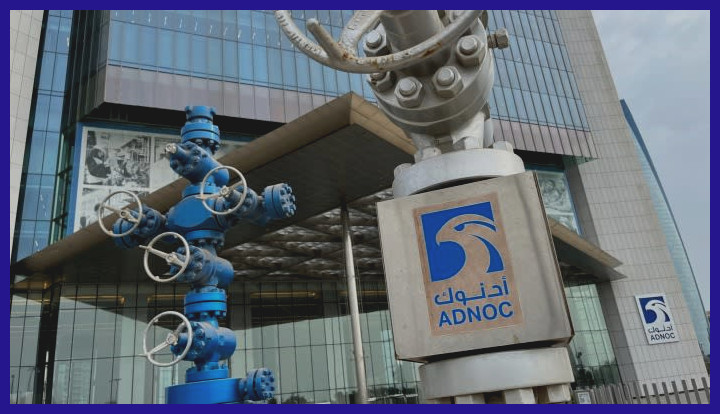
Outside the gleaming headquarters of the National Oil Company (Adnoc) in Abu Dhabi, a colossal replica of an oil rig stands sentinel, a stark monument to the opulence woven into the very fabric of the city’s identity. Yet, within the towering 340-meter edifice, a more complex narrative unfolds. Adnoc’s executives grapple with a monumental task: how to “future proof” the venerable oil titan over the ensuing quarter of a century, as global society endeavors to disentangle itself from the clutches of fossil fuels and align with ambitious climate targets.
Adnoc, akin to European giants like Shell, TotalEnergies, and BP, has embarked on an aggressive investment spree, pouring up to $5 billion annually into the realm of low-carbon energy—a staggering commitment that eclipses even that of major U.S. players. In a striking bid to enhance its sustainability credentials, the company has set its sights on achieving net-zero emissions by 2045—five years ahead of competitors—and is diversifying into hydrocarbon-derived products like plastics, strategically anticipating the inevitable decline of gasoline and diesel demand. The recent announcement of a $16 billion acquisition of Covestro, a German expert in polyurethane and polycarbonate, signals Adnoc’s shift in focus.
However, in stark contrast to its European counterparts, who are bracing for the peak of oil production in the imminent decade, Adnoc aspires to be among the last bastions of oil extraction. Consequently, it is making significant strides to boost its crude oil output while banking on a robust future for gas.
“The paramount challenge that players like us face lies not in how to substitute our energy systems but rather how to decarbonize them,” Musabbeh Al Kaabi, Adnoc’s executive director for low-carbon solutions and international growth, articulated during an interview. “Perhaps a complete transition will take an extended period, yet our principal focus now is to decarbonize our current energy sources while simultaneously investing in the sustainable energy landscape of tomorrow.”
Since its inception in 1971, the United Arab Emirates (UAE)—a federation of seven city-states hugging the northern Arabian coast, with Abu Dhabi at the helm—has been deeply ingrained in oil dependency. The nation boasts some of the globe’s highest-quality reserves, wielding a remarkable daily production capacity of 4.85 million barrels and an astounding 11.5 billion cubic feet of gas, as revealed in a recent $4 billion bond offering prospectus. Astonishingly, last year, over 40 percent of the $310 billion GDP of Abu Dhabi was rooted in fossil fuels.
In a pivotal address back in 2017, coinciding with Shell’s contemplations of energy transition, Sheikh Mohamed bin Zayed Al Nahyan, the ruler of Abu Dhabi, underscored the pressing need for a long-term strategy to navigate oil’s diminishing significance in the global economic arena. Today, Abu Dhabi strides towards an economic diversification that ventures into chemicals and artificial intelligence.
A sustainable vision propels both Abu Dhabi and Adnoc toward greener energy endeavors. This year, the capital revealed that a quarter of the UAE’s electricity is now sourced from its nuclear power plant, while aspiring to achieve a remarkable 44 percent renewable energy share by 2050.
Adnoc is harnessing both solar and nuclear resources for its onshore operations, investing $3.8 billion to connect its offshore facilities to the grid—a move poised to halve its offshore carbon emissions. Moreover, the company claims it will capture carbon dioxide from its $18 billion Hail and Ghasha project, thus forging a net-zero oil and gas field. The overarching ambition is clear: substantially curtail domestic oil and gas consumption to amplify export potential.
“What the UAE has excelled at is substituting domestic gas consumption with clean energy, including solar and nuclear, thus liberating a significant portion of this gas for export,” noted Aditya Saraswat, head of Middle East and North Africa research at Rystad Energy, an energy consultancy.
As the Middle East pivots towards natural gas, many in the region view it as integral to the energy transition narrative, given its comparatively lower carbon emissions and cost-effectiveness as a baseload power source. However, the methane emissions associated with gas remain a concern, surpassing those of oil or coal.
“If you consider all credible energy forecasts leading to 2050, it’s evident that natural gas will significantly contribute to the energy mix,” remarked Al Kaabi, adding that by 2040, Asia is projected to account for 70 percent of liquefied natural gas (LNG) demand.
A consultant privy to Adnoc’s strategy noted that the realignment of Europe’s gas landscape, particularly following Russia’s invasion of Ukraine, has opened avenues for UAE and Qatar to capitalize on gas exports. In the first half of this year, Adnoc inked three international gas pacts in Azerbaijan, Mozambique, and the U.S., with Rystad forecasting that two-thirds of Adnoc’s anticipated $45 billion investment over the next three years will be channeled into gas ventures.
The third pillar of Adnoc’s strategic architecture centers on the chemicals sector, as the company embarks on an ambitious journey to cultivate three key product chains: ammonia, plastics, and foams. Notably, even before securing the Covestro acquisition, Adnoc had already taken decisive steps in deal-making, investing $3.6 billion to seize control of the fertilizer enterprise Fertiglobe last December, and finalizing an acquisition worth approximately $3.3 billion in Austrian chemicals and energy giant OMV. Negotiations are also underway to merge Borouge—Adnoc’s chemicals subsidiary—with OMV’s Borealis, illustrating a clear forward-thinking trajectory.
This calculated entry into Germany’s industrial epicenter is expected to bolster relationships vital for Adnoc’s gas and anticipated low-carbon hydrogen initiatives, as one foreign oil executive postulated. This distinguishes Adnoc’s approach from that of Saudi Arabia, which has pursued stakes in Chinese refineries—essentially focusing on crude placement.
“Our emphasis is not merely on selling crude; it transcends that—it revolves around future-proofing our operations by discerning what the world demands and how we can position ourselves as a strategic long-term investor committed to delivering energy in its most requisite forms,” Salmeen asserted.