

Concise Overview
September 23, 2024
Data supply: Evaluate Energy
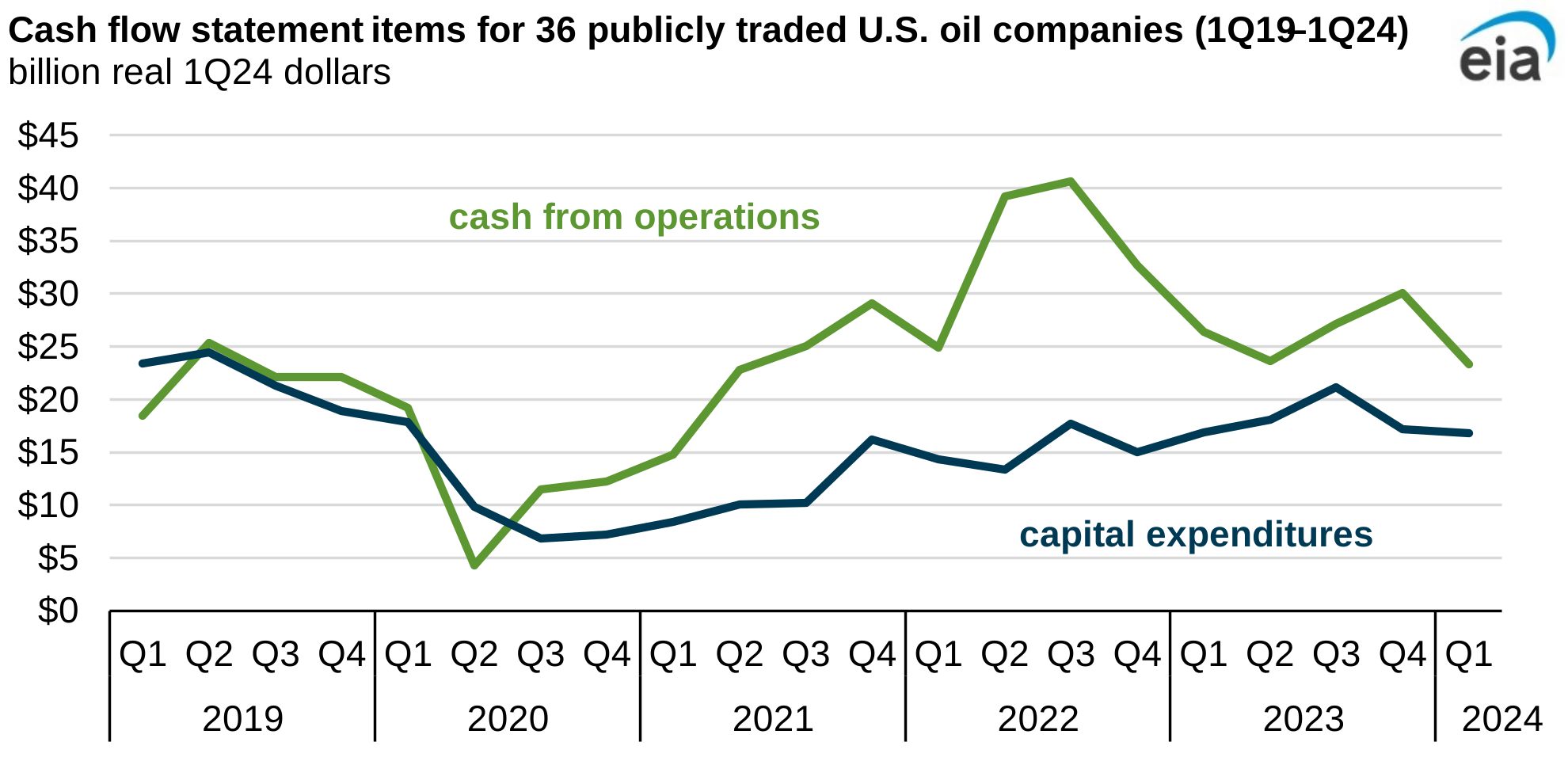
In a placing flip of occasions, monetary information from 36 publicly traded oil exploration and manufacturing (E&P) corporations unveil a downward pattern in money from operations for the primary quarter of 2024—a decline ascribed to plummeting natural gas costs, starkly contrasting with figures from the identical quarter in 2023.
Operational prices, a big variable impacting money movement, seem to have stabilized after a tumultuous interval marked by provide chain disruptions. Those points, which as soon as drove prices upwards, now appear to be largely behind us. Interestingly, capital expenditures—an indicator of funding in the oil and gas sectors—have remained stagnant over the comparative timeframe.
Delving deeper, the primary quarter of 2024 witnessed a 12% discount in money from operations, tumbling to $23.3 billion consequently of decrease crude oil and natural gas costs. While West Texas Intermediate crude oil costs dipped a mere 2%, U.S. crude manufacturing surged 5%, edging nearer to a staggering 4.2 million barrels per day (b/d).
Persistent manufacturing cuts orchestrated by OPEC+, meant to buoy crude oil costs, have inadvertently empowered non-OPEC+ producers, notably U.S. drillers. One would possibly anticipate this uptick in manufacturing to bolster money flows; nonetheless, the radically diminished natural gas costs stifled potential income streams for these corporations.
An astonishing 26% drop in natural gas costs from Q1 2023 to Q1 2024 has pushed costs to their lowest month-to-month common, inflation-adjusted, since at least 1997. Though these corporations predominantly chase crude oil manufacturing, it’s noteworthy that natural gas nonetheless constitutes roughly 30% of their output, primarily as a result of intricacies of crude oil deposits and the extra diversified scope of operations amongst sure E&P companies.

Data supply: Bloomberg L.P.
Note: WTI=West Texas Intermediate, 1Q19=first quarter of 2019, 1Q24=first quarter of 2024
Analyzing the shifts in manufacturing bills—spanning the prices of items bought, operational bills, and manufacturing taxes—reveals a dramatic rise per barrel of oil equal (BOE) in 2021 and 2022, primarily fueled by provide chain debacles that noticed materials and labor prices skyrocket, greater than doubling from 2019 averages. Yet, since then, a notable decline of 40% has emerged, notably between the apex of Q2 2022 and up to date figures from Q2 2023.
As we entered the second half of 2023, manufacturing bills leveled off, averaging round $26/BOE. Alongside enhancements in provide chains, developments in drilling effectivity and elevated takeaway capability in the Permian area have conspired to curtail manufacturing bills on a BOE foundation.

Data supply: Evaluate Energy
Note: 1Q19=first quarter of 2019, 1Q24=first quarter of 2024
Our insights draw from the monetary stories of 36 publicly traded oil corporations, representing a considerable slice of the U.S. crude oil panorama. However, it’s salient to notice that these observations don’t encapsulate everything of the sector, as non-public corporations, which don’t disclose financials, are absent from this evaluation. Notably, the 36 corporations featured right here accounted for a commendable 32% of U.S. crude oil manufacturing in Q1 2024, translating to a powerful 4.2 million barrels per day.
Principal contributor: Alexander de Keyserling